

Why Buy an E-Bike From a Local Shop Instead of Online?
Buying an e-bike online can be tempting. The price may look lower, the pictures look clean, and the website may promise long range, high speed, and easy assembly. But an electric bike is not just a regular bicycle with a battery added. It is a bicycle, a transportation tool, and an electrical system working together.
For many first-time e-bike riders, the real question is not just, “Which bike is cheapest?” The better question is, “Which e-bike will actually fit me, feel comfortable, be safe to charge, be legal to ride, and be serviceable after I buy it?”
That is where buying from a local e-bike shop can make a major difference.
An E-Bike Is More Than a Regular Bike
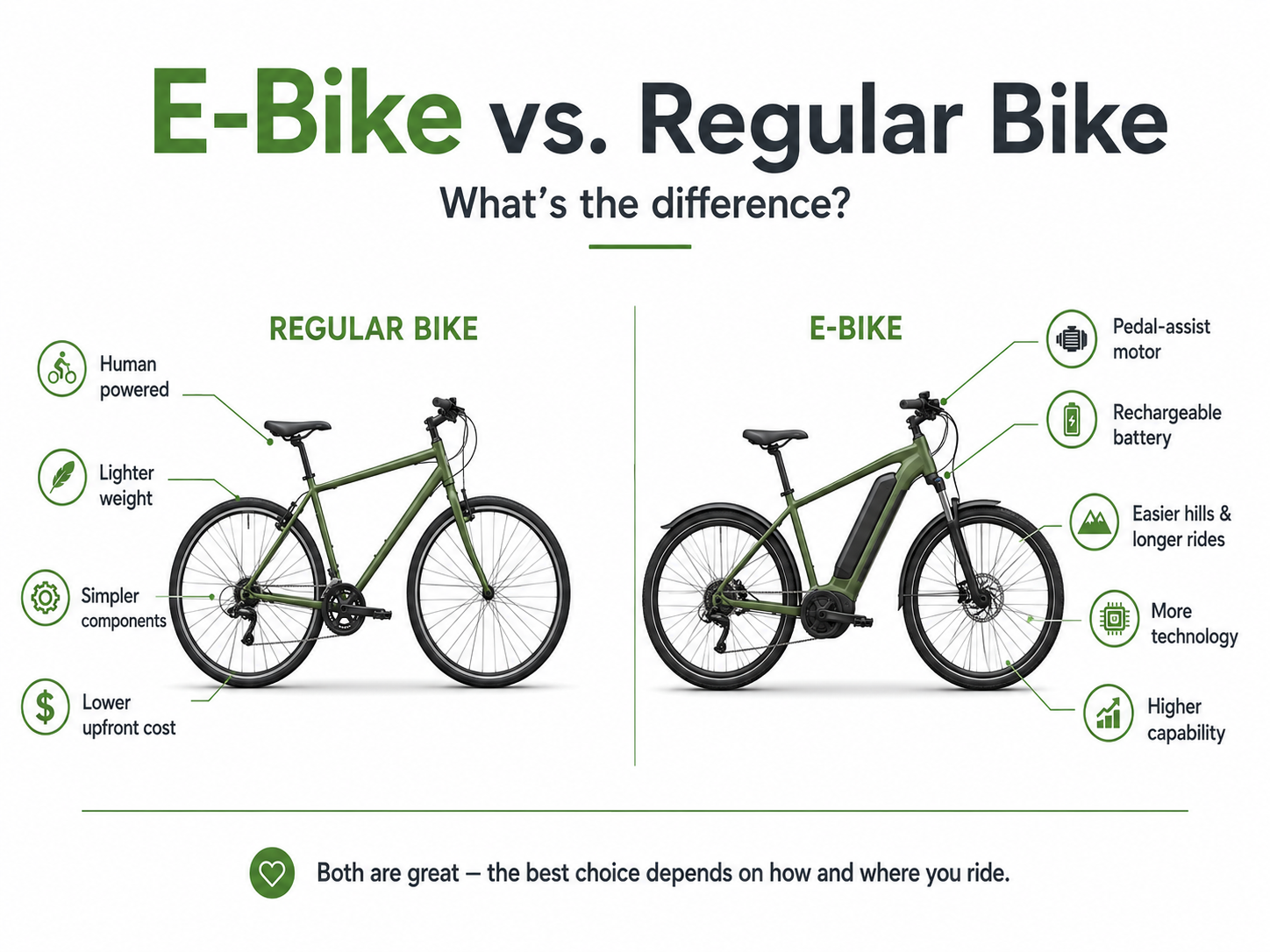
A traditional bicycle is powered entirely by the rider. An e-bike still has pedals, gears, brakes, wheels, and a frame, but it also adds a motor, battery, controller, sensors, wiring, and a charger. Under U.S. federal law, a low-speed electric bicycle is generally defined as a two- or three-wheeled vehicle with fully operable pedals, an electric motor under 750 watts, and a maximum motor-powered speed below 20 mph under the federal test definition.
That added electrical system is what makes an e-bike so useful. It can help riders climb hills, ride farther, carry cargo, commute with less sweat, and keep up with friends or family. Research has found that e-bike riders often take longer trips than conventional cyclists, and that physical activity gains from active travel can be similar between e-bike users and conventional cyclists.
E-bikes can also still provide real exercise. A systematic review published in the International Journal of Behavioral Nutrition and Physical Activity found moderate evidence that electrically assisted cycling provides physical activity of at least moderate intensity, generally lower than conventional cycling but higher than walking.
So when comparing an e-bike to a regular bike, the price difference is not only about the motor. It is about the complete system: battery quality, motor performance, braking power, wiring, sensors, frame strength, software, charger compatibility, and long-term service.
Why Online E-Bikes Often Look Cheaper
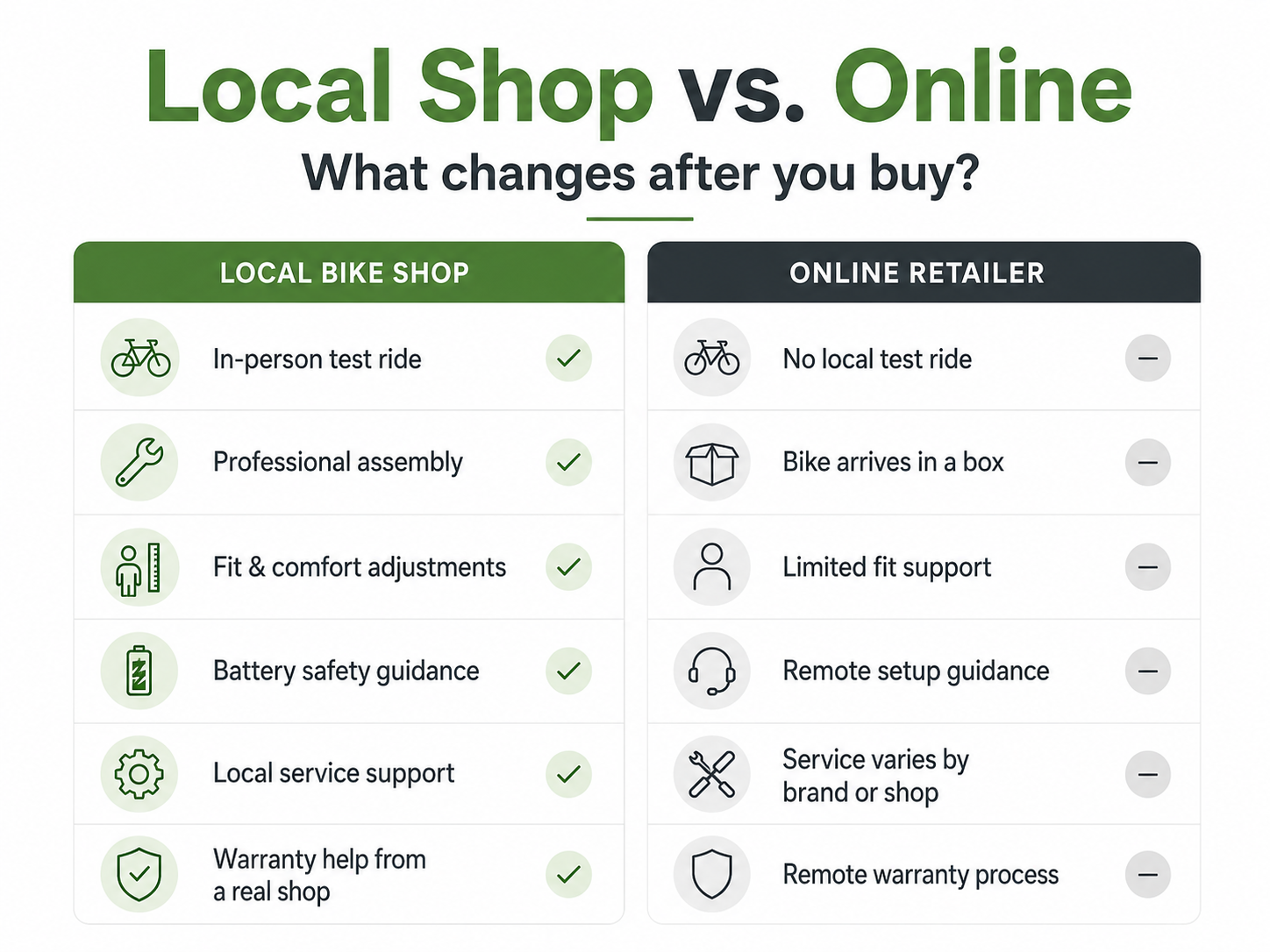
Online e-bikes may look less expensive because many are sold direct-to-consumer. That can reduce storefront and dealer costs, but it can also shift more responsibility onto the customer.
When an e-bike arrives in a box, the buyer may still need to install parts, adjust brakes, align handlebars, check bolts, inspect wheels, and make sure the bike is safe before riding. Trek’s owner guidance warns that many bicycle service and repair tasks require special knowledge and tools, and that assembly and first adjustment should be done by a bike shop or qualified bicycle mechanic.
For a regular bicycle, poor assembly can cause shifting problems, rubbing brakes, loose handlebars, or unsafe wheels. For an e-bike, the stakes can be higher because the bike is usually heavier, faster, and includes electrical components.
The Test Ride Matters
One of the biggest advantages of buying locally is the test ride.
E-bikes can feel very different from one another. A commuter e-bike, cargo e-bike, cruiser e-bike, folding e-bike, and performance e-bike may all technically be “electric bikes,” but they can ride completely differently. Motor placement, battery size, tire width, frame geometry, handlebar position, saddle comfort, brake quality, and weight all affect how the bike feels.
A local shop lets customers compare models in person and answer questions like:
Does the bike feel stable?
Is the frame easy to step over?
Is the motor smooth or too jumpy?
Is the bike too heavy to lift or store?
Does the rider prefer throttle, pedal assist, or both?
Is the riding position comfortable for longer rides?
Will the bike work for commuting, trails, errands, or recreation?
Local Shops Help You Buy the Right Type of E-Bike
Not every e-bike is right for every rider. Some customers want an easy recreational bike for the Monon Trail. Others want a commuter bike, a cargo bike, a folding bike, or something powerful enough for hills and longer distances.
Local shops help match the bike to the rider’s actual use. That matters because e-bikes are commonly discussed in Class 1, Class 2, and Class 3 categories, and those classes affect how the motor works, how fast assistance continues, and where the bike may be allowed. PeopleForBikes explains that the three-class system was designed for low-speed electric bicycles that closely resemble traditional bicycles in equipment, handling, size, and speed.
A local shop can help explain the practical difference:
Class 1: Pedal assist only, usually assisted up to 20 mph.
Class 2: Pedal assist plus throttle, usually assisted up to 20 mph.
Class 3: Pedal assist only, usually assisted up to 28 mph.
That guidance matters because the “fastest” e-bike online is not always the best or most appropriate choice. A rider may need comfort, safety, legal trail access, service support, or cargo capability more than raw speed.
Battery Safety Is a Major Reason to Buy Carefully
The battery is one of the most important parts of an e-bike. A quality battery can make the bike reliable, convenient, and safe to charge. A poor-quality or mismatched electrical system can create serious problems.
The U.S. Consumer Product Safety Commission warns consumers to follow manufacturer charging instructions, stay present while charging, avoid charging while sleeping or away from home, use only the charger provided or recommended by the manufacturer, and avoid modified or reworked battery packs.
CPSC has also specifically warned consumers not to use “universal” chargers for e-bikes and other micromobility products unless the charger has been tested and approved to work safely with that device. CPSC notes that chargers may physically fit a device but still be electrically incompatible, which can cause a battery to ignite.
This is one reason a reputable local shop matters. Customers can ask real questions before buying:
What charger comes with this bike?
Is the battery removable?
Is the charger approved for this exact model?
What should I do if the battery is damaged?
Can replacement batteries be ordered later?
Is the electrical system certified or tested to recognized safety standards?
UL Certification and Electrical System Quality Matter
A major safety topic in the e-bike industry is UL 2849. UL Solutions explains that UL 2849 evaluates the e-bike electrical drive train, battery system, and charger system together for electrical and fire safety.
That distinction is important. A battery cell, battery pack, motor, and charger may each sound impressive in an online listing, but an e-bike is safest when the complete electrical system is designed to work together. UL states that UL 2849 examines the electrical drive train, battery system, and charger system combinations, and also covers risks such as electric shock during charging.
A local shop can help customers understand what safety claims actually mean instead of relying only on online marketing terms.
Service After the Sale Is One of the Biggest Differences
The purchase is only the beginning of owning an e-bike.
Like regular bikes, e-bikes still need tire service, brake adjustments, drivetrain maintenance, wheel checks, spoke tension, firmware or diagnostic support, and occasional part replacement. But e-bikes can also involve brand-specific batteries, displays, sensors, motor systems, wiring harnesses, chargers, and diagnostic tools.
That means buying an e-bike online can become frustrating if no local shop is willing or able to service it. Some shops are cautious about working on unknown e-bikes because of electrical safety, liability, unsupported parts, or lack of documentation. Industry reporting has noted that some e-bikes sold online may fall outside normal Class 1, 2, or 3 categories, use nonstandard parts, or lack repair support, which can make local service difficult.
When you buy from a local shop, you are not just buying the bike. You are buying access to people who know how to assemble it, explain it, maintain it, and support it after the sale.
A Local Shop Can Help With Fit and Comfort
Fit is one of the most overlooked parts of buying an e-bike.
A bike that is too large, too small, too heavy, too aggressive, or too uncomfortable may sit unused even if it looked like a great deal online. A local shop can adjust saddle height, handlebar position, brake lever reach, tire pressure, suspension setup, and accessories to make the bike more comfortable.
That matters especially for new riders. Many customers buying their first e-bike are not trying to become professional cyclists. They want to ride comfortably, feel safe, and enjoy the experience.
Local Shops Help You Understand Real Range
Online listings often advertise range numbers, but real-world range depends on many factors:
Rider weight
Cargo weight
Tire pressure
Assist level
Hills
Wind
Temperature
Stop-and-go riding
Battery age
Motor efficiency
Riding speed
A local shop can explain what range is realistic for your type of riding. A customer riding casually on a flat trail may get very different range from someone commuting with cargo, using high assist, or riding into wind.
This helps prevent disappointment. Instead of buying based on the biggest advertised number, customers can buy based on how they actually plan to ride.
Online Buying Is Not Always Bad — But It Has Risks
Buying online is not automatically wrong. Some online e-bike brands are reputable, well-designed, and safe. The issue is that online shopping makes it harder for customers to judge quality, fit, safety, serviceability, and long-term support before purchasing.
The lower price may be attractive, but customers should ask:
Who will assemble the bike?
Who will service it locally?
Are replacement parts available?
Is the battery safe and properly certified?
Is the charger approved for that exact battery?
Is the company easy to contact?
Is the bike legal for where I want to ride?
Can I test ride it before buying?
What happens if something breaks after 6 months?
If those answers are unclear, the “cheap” e-bike may become more expensive over time.
Why Buying Local Can Be Worth the Higher Price
A local e-bike shop provides value that does not always show up on a price tag.
When you buy from a local shop, you can usually get:
Professional assembly
Test rides
Fit adjustments
Real product education
Help choosing the right class and style
Safer charger and battery guidance
Local service after the sale
Warranty support
Accessory installation
Maintenance reminders
A real person to ask when something feels wrong
That support is especially valuable for first-time e-bike riders. The goal is not just to own an e-bike. The goal is to own one that you understand, enjoy, and feel confident riding.
Final Thought
An e-bike is an investment in transportation, recreation, health, and convenience. Buying online may save money upfront, but buying from a local shop can help protect that investment through better fit, safer setup, product education, service support, and long-term confidence.
At Future Velo, we believe customers should understand what they are buying before they spend thousands of dollars on an e-bike. Whether you are comparing e-bikes to regular bikes, wondering why e-bikes cost more, or trying to decide between buying online and buying locally, our goal is to help you choose the right bike for your actual life.
The best e-bike is not always the cheapest one online. It is the one you will ride, maintain, trust, and enjoy for years.
Suggested Call-to-Action
Thinking about buying your first e-bike? Visit Future Velo in Carmel, Indiana to test ride different models, compare features, and get expert help choosing the right e-bike for your riding style.
Credible Sources
Cornell Legal Information Institute — U.S. federal definition of low-speed electric bicycles
PeopleForBikes — electric bicycle policy and three-class system
U.S. Consumer Product Safety Commission — micromobility and battery charging safety
UL Solutions — UL 2849 e-bike electrical system certification
International Journal of Behavioral Nutrition and Physical Activity — research review on e-bike physical activity
Transportation Research Interdisciplinary Perspectives — study comparing e-bike and conventional bike physical activity
Trek Owner’s Manual — professional bicycle assembly and mechanical work guidance