

How to Pick an E-Bike in Carmel, Indiana
Choosing an e-bike is not just about picking the fastest model or the lowest price. In Carmel, Indiana, the best e-bike depends on where you ride, how comfortable you want to feel, how much support you need, and whether the bike fits Indiana’s e-bike rules.
Carmel is especially well suited for e-bike riding because of its trail system, bike routes, neighborhoods, and access to destinations like Midtown, City Center, the Arts & Design District, and the Monon Greenway. The Carmel Access Bikeway includes eight cross-city bike routes and five bike loops designed to connect riders to destinations throughout the city and nearby communities.
At Future Velo in Carmel, we often help riders compare comfort, range, motor type, safety, and long-term serviceability. Here is how to choose the right e-bike for your riding style.
1. Start With Where You Plan to Ride
Before comparing motors and batteries, think about your real use case.
For Carmel riders, common e-bike uses include:
Riding the Monon Greenway
Commuting to work or school
Running errands around Carmel, Westfield, Fishers, or Indianapolis
Recreational weekend rides
Replacing short car trips
Riding with family or friends
Getting back into cycling with less strain
The Monon Trail is one of the most important local riding corridors. Carmel Clay Parks describes the Monon Greenway as an asphalt trail stretching from Westfield south to downtown Indianapolis. Visit Hamilton County also notes that the Monon Trail connects through Hamilton County and extends more than 20 miles north through Westfield and Grand Park toward Sheridan.
For trail riding and relaxed city riding, comfort and control usually matter more than top speed. For commuting, range, lights, fenders, racks, tires, and reliability become more important.
2. Understand Indiana E-Bike Classes
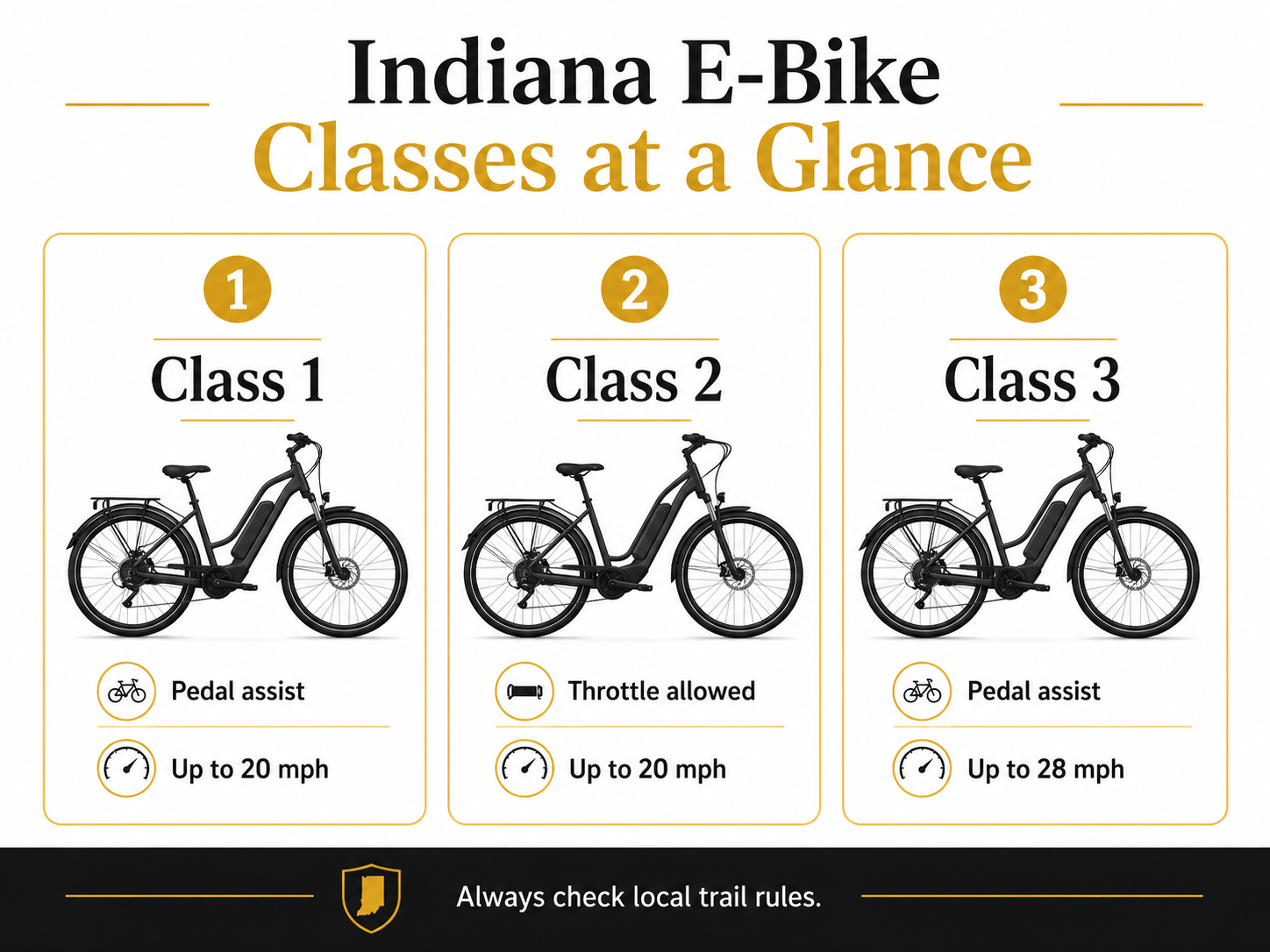
How different classes of E-bike differ
Indiana recognizes three main e-bike classes. According to the Indiana Department of Natural Resources, Class 1 e-bikes are pedal-assist only, have a motor of 750 watts or less, and assist up to 20 mph. Class 2 e-bikes also have a motor of 750 watts or less and assist up to 20 mph, but they may include a throttle. Class 3 e-bikes are pedal-assist only, have a motor of 750 watts or less, and assist up to 28 mph.
For many Carmel riders, a Class 1 or Class 2 e-bike is the most practical choice for recreation, trails, and casual transportation. A Class 3 e-bike may be better for commuters who ride longer distances or need to keep pace on roads, but it may not be ideal for every trail or every rider.
A good rule is simple: choose the class that matches your riding environment, not just the highest speed available.
3. Choose the Right Purpose for the E-bike
Comfort is one of the biggest reasons people either love or stop using their e-bike.
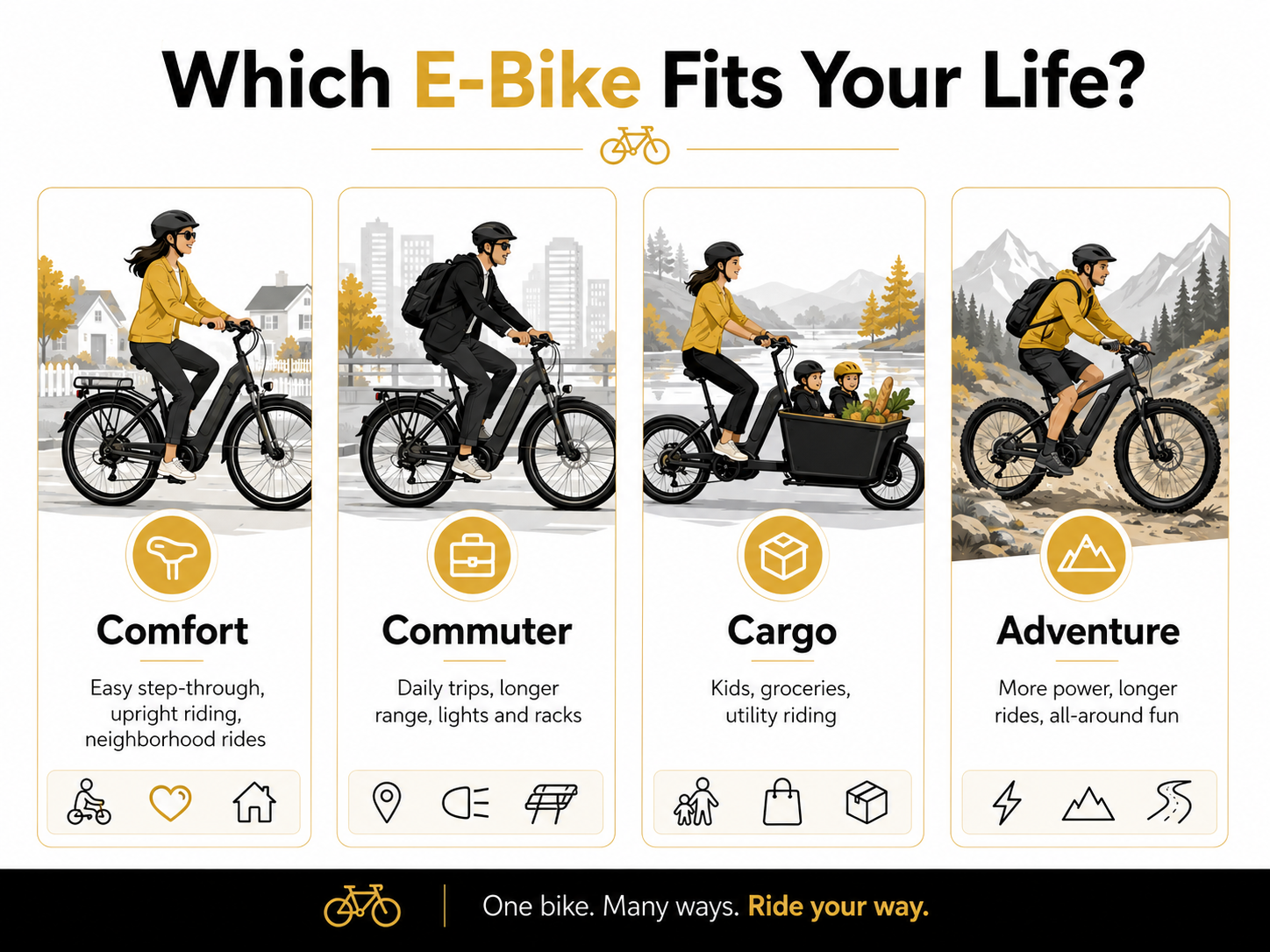
Find the E-bike style that fits best for your needs
There are three common riding styles:
Upright comfort e-bikes are best for relaxed riders, older adults, casual trail riders, and people who want less pressure on the back, wrists, and shoulders. Models such as the Gazelle Arroyo series and Easyflow series are highly recommended for its comfortness.
Commuter e-bikes usually balance comfort and efficiency. They often include racks, fenders, lights, and a riding position that works for both trails and roads. Models such as the Gazelle Medeo series, Serfas E-bikes, or Segway Myon are all recommended for daily commuting.
Sportier e-bikes are better for riders who want quicker handling, longer rides, or a more active cycling feel. Models such as the Gazelle Ultimate series, Eclipse series, or Macfox E-bikes are best fits for adventurous riders.
Cargo e-bikes are often the best fit for families with elders and children. They often have excessive areas for passengers to ride comfortably while having room for more storage, making it more convenient for families to enjoy bike rides together. Models such as the Urban Arrow series, Benno series, and Segway MUXI are built to meet the needs of bigger families.
For many Carmel riders, especially those using the Monon or riding around neighborhoods, an upright or slightly upright commuter e-bike is the safest starting point.
4. Do Not Buy Based on Range Numbers Alone
Many e-bike listings advertise large range numbers, but real-world range depends on rider weight, hills, tire pressure, temperature, wind, speed, assist level, cargo, and how often you stop and start.
In Indiana, weather matters too. Cold temperatures can reduce battery performance, and riders who store or charge batteries improperly may shorten battery life. Bosch recommends charging and storing e-bike batteries at room temperature during cold winter conditions and only installing the battery shortly before riding.
Instead of asking, “What e-bike has the longest range?” ask:
“Can this e-bike comfortably handle my normal ride with extra battery left over?”
For most local riders, it is better to buy a reliable e-bike with realistic range than a cheaper e-bike with exaggerated online claims.
5. Pay Attention to Battery and Electrical Safety
Battery quality is one of the biggest differences between a good e-bike and a risky one.
The National Fire Protection Association warns that damaged lithium-ion batteries can overheat, catch fire, and even lead to explosions. UL Solutions explains that the UL 2849 standard evaluates an e-bike’s electrical drive train system, battery system, and charger system together for electrical and fire safety.
This is one reason buying from a local e-bike shop can matter. A reputable shop can help you understand the battery, charger, warranty, software system, and service options before you buy.
When comparing e-bikes, look for:
A reputable battery system
A proper charger from the manufacturer
Clear warranty support
Safe charging instructions
Serviceable wiring and components
A brand with parts availability
A very cheap e-bike may save money upfront, but if the battery, controller, charger, or wiring is low quality, it can become more expensive and harder to service later.
6. Decide Between Hub Drive and Mid-Drive
Most e-bikes use either a hub motor or a mid-drive motor.
A hub-drive e-bike has the motor in the wheel. These bikes are often more affordable and can feel simple and direct. They can be a good fit for casual riders, flat routes, and value-focused buyers.
A mid-drive e-bike has the motor near the pedals. These systems usually feel more natural because the motor works through the bike’s drivetrain. Mid-drives are often better for hills, heavier loads, longer rides, and riders who want a more refined cycling experience.
For Carmel’s general terrain, both can work well. The better choice depends on your budget, riding feel, service expectations, and how often you ride.
7. Think About Fitness, Not Just Convenience
E-bikes are sometimes misunderstood as “not real exercise,” but research does not support that simple assumption.
A systematic review published in the International Journal of Behavioral Nutrition and Physical Activity concluded that electrically assisted cycling can contribute to meeting physical activity recommendations and improving physical fitness. Another systematic review and meta-analysis found that e-bikes can help riders control exertion, reduce concerns about distance and hills, and extend the realistic active transportation radius compared with conventional bicycles.
That makes e-bikes especially useful for people who want to ride more often, ride farther, or return to cycling without overexertion.
The best e-bike is not the one that does everything for you. It is the one that makes you ride more.
8. Consider Safety Features Before Accessories
A good e-bike should feel stable, predictable, and safe.
Important safety features include:
Hydraulic disc brakes
Integrated front and rear lights
Reflective tires or sidewall visibility
Proper tire width for comfort and control
A frame size that fits your body
A step-through frame if mounting and dismounting is difficult
Reliable drivetrain and shifting
Quality tires for pavement, trails, and wet conditions
NHTSA reminds cyclists to ride with traffic, obey traffic signs and signals, use bike lanes when available, and avoid distractions while riding. The right e-bike should make those habits easier by giving you good visibility, stable braking, and confident handling.
9. Test Ride Before You Buy
An e-bike can look perfect online and still feel wrong in person.
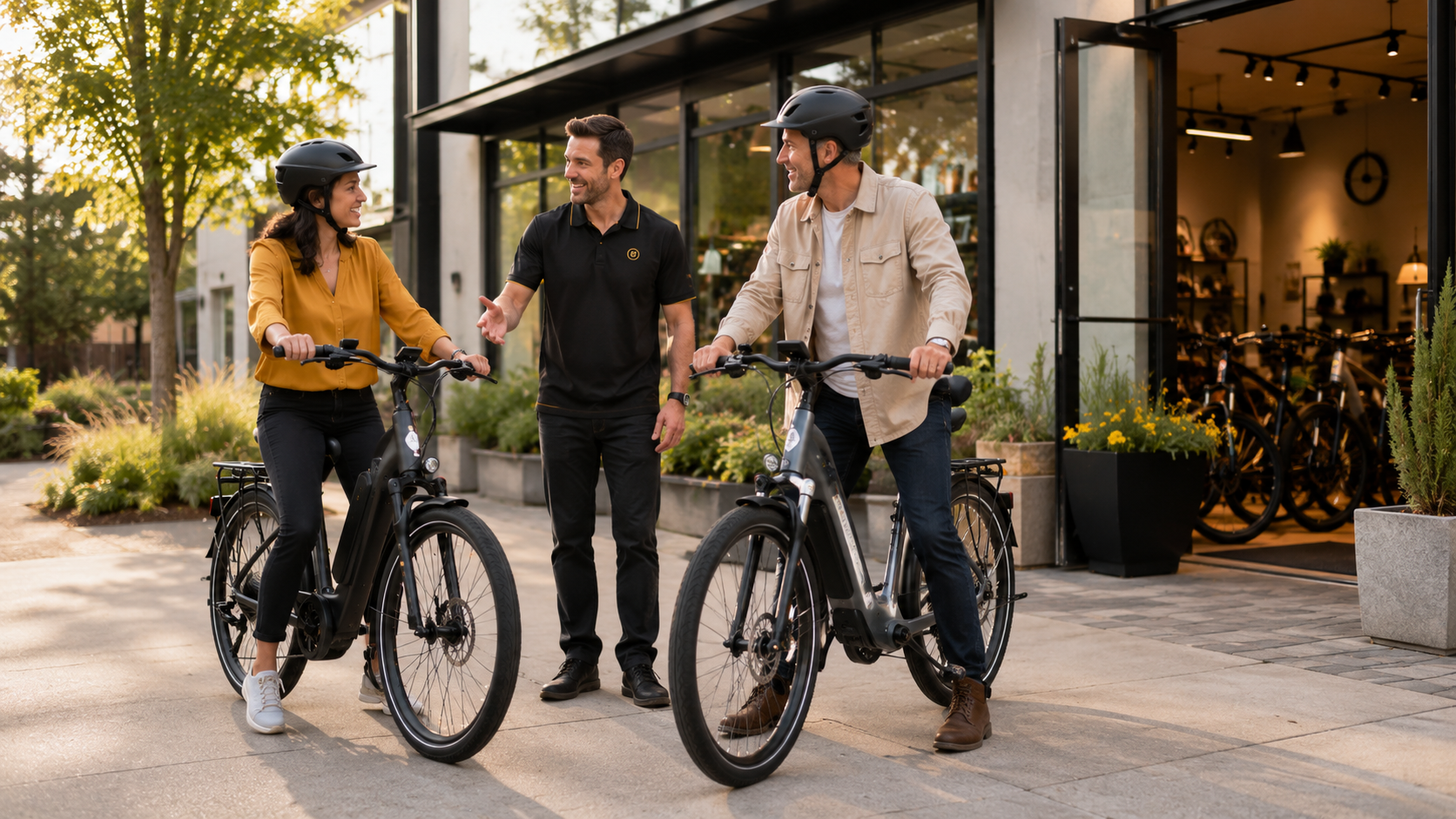
Test ride E-bikes to find out fits you the best!
During a test ride, pay attention to:
How easy it is to get on and off
Whether the bike feels too heavy
How natural the motor assistance feels
Whether the brakes feel controlled
Whether the handlebars feel comfortable
Whether the display is easy to understand
Whether the bike feels stable at low speed
Whether the riding position feels relaxed or strained
This is especially important for new riders. A 10-minute test ride can reveal more than hours of online comparison.
10. Buy for Long-Term Support
The best e-bike is not just a product. It is a transportation system that needs service, software support, parts, tires, brakes, updates, and occasional diagnostics.
Before buying, ask:
Can this bike be serviced locally?
Are replacement parts available?
Is the battery from a known system?
Does the brand have warranty support?
Can the shop diagnose electrical issues?
Will the bike still be practical after several years?
For riders in Carmel, buying from a local shop like Future Velo means you can test ride before purchasing, get help choosing the right model, and return for service when the bike needs maintenance.
Final Recommendation: Match the E-Bike to Your Life
The right e-bike for Carmel depends on your real riding habits.
Choose a comfort e-bike if you want relaxed neighborhood and trail rides. Choose a commuter e-bike if you want to replace short car trips or ride to work. Choose a more powerful mid-drive model if you want longer rides, better hill performance, or a premium riding feel. Choose a step-through frame if ease of use matters most.
Most importantly, choose an e-bike that feels safe, comfortable, serviceable, and enjoyable enough that you will actually ride it.
At Future Velo in Carmel, Indiana, we help riders compare e-bikes in person, test ride different styles, and find a model that fits their body, route, and budget.
For many Carmel riders, a comfort e-bike like the Gazelle Arroyo is a great fit for relaxed trails and neighborhood riding. Riders who want the easiest step-through experience may prefer the Gazelle Easyflow C7, while commuters and longer-distance riders may want to compare the Gazelle Eclipse series. Families or utility-focused riders may also want to explore cargo-style options from brands like Urban Arrow or Benno.
The best next step is to compare these models in person, test ride different frame styles, and choose the bike that feels right for your body, route, and riding goals.