

E-Bike Repair Near Carmel, Indiana: What to Know Before Bringing Your Bike In
E-bikes are one of the best ways to ride farther, commute more easily, and enjoy local paths around Carmel, Westfield, Fishers, Noblesville, and North Indianapolis. But when something goes wrong, repairing an e-bike can be very different from repairing a traditional bicycle.
At Future Velo in Carmel, Indiana, we help riders with e-bike diagnostics, mechanical repairs, electrical troubleshooting, maintenance, and long-term support. Whether your e-bike has a flat tire, worn brakes, a battery issue, an error code, or a motor that suddenly stopped working, understanding how e-bike repair works can help you know what to expect before bringing your bike in.
Why E-Bike Repair Is Different From Regular Bike Repair
A traditional bicycle is mostly mechanical. A mechanic can inspect the brakes, tires, drivetrain, wheels, bearings, cables, chain, cassette, derailleur, and frame without needing to evaluate an electrical system.
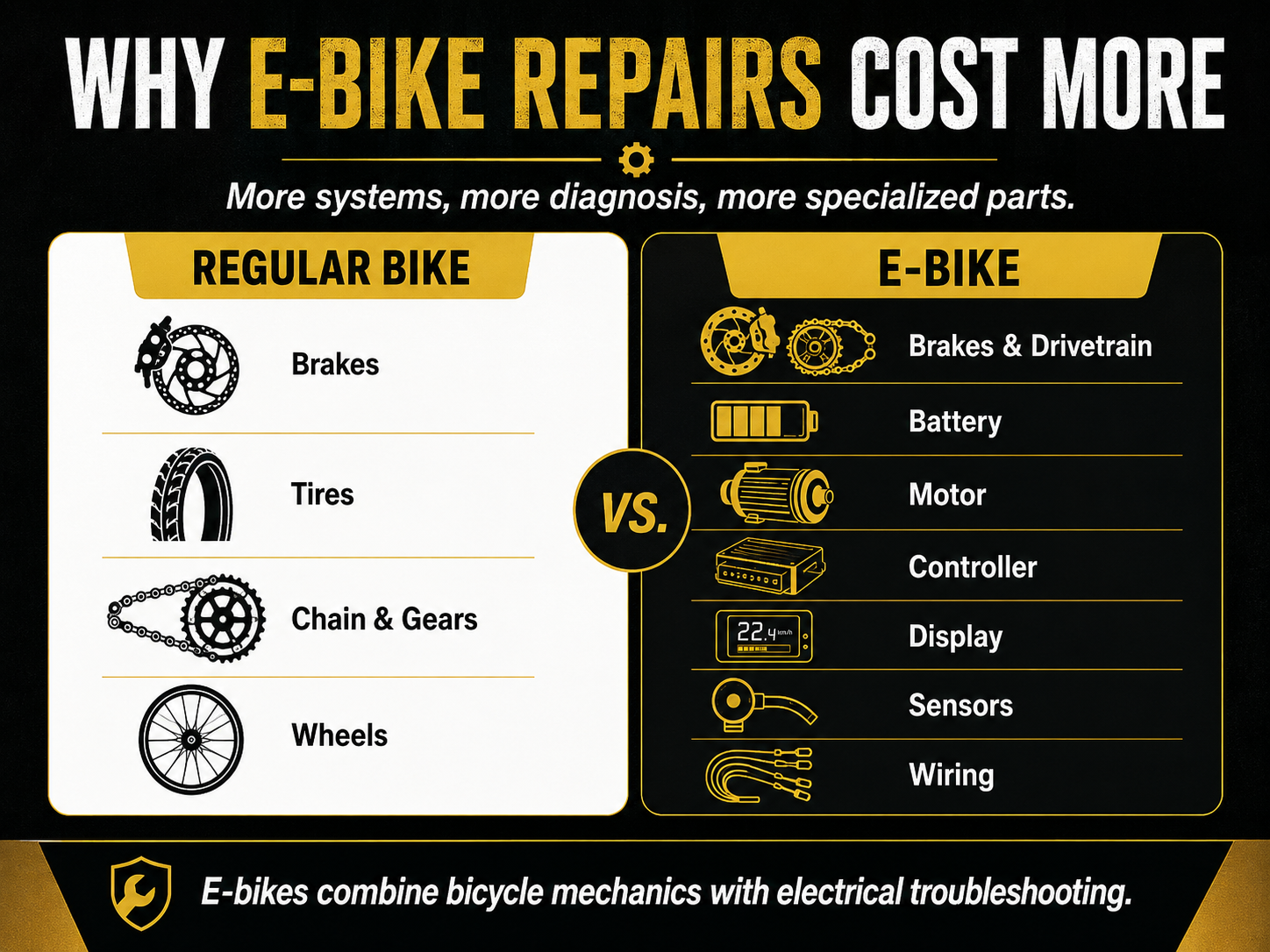
An e-bike includes all of those normal bicycle parts, but it also adds an electrical drive system. Depending on the bike, that may include:
Battery
Charger
Motor
Controller
Display
Wiring harness
Speed sensor
Torque sensor or cadence sensor
Brake cut-off sensors
Throttle
Software or firmware
Error codes
Proprietary connectors
Brand-specific diagnostic tools
That means an e-bike repair often requires both bicycle mechanical knowledge and electrical troubleshooting. A simple symptom, such as “the bike will not turn on,” may have several possible causes: a battery problem, charger issue, loose connector, damaged wiring, failed display, controller fault, blown fuse, motor communication error, or software-related issue.
This is one reason e-bike diagnostics may cost more than standard bicycle repair. The repair process often takes more time because the technician is not only fixing a mechanical part; they may also need to trace electrical signals, check system compatibility, inspect safety risks, research brand-specific components, and determine whether replacement parts are available.
Why Diagnostics Matter
A diagnostic is not just a quick look at the bike. It is the process of narrowing down the cause of the issue before replacing parts.
For example, if an e-bike does not turn on, replacing the battery immediately may not be the right answer. The problem could be the charger, display, wiring, controller, battery mount, or even water damage inside a connector. If the motor cuts out while riding, the issue could come from the speed sensor, brake sensor, motor cable, battery connection, controller, or software.
A proper diagnostic helps avoid unnecessary part replacement. It also helps the shop determine whether the bike is safe to ride and whether the repair is practical.
At Future Velo, electrical diagnostic work may include inspecting connectors, testing charger behavior, checking the battery connection, reviewing error codes when available, inspecting wiring, checking sensors, confirming mechanical condition, and researching replacement parts or brand support.
Common E-Bike Problems We See
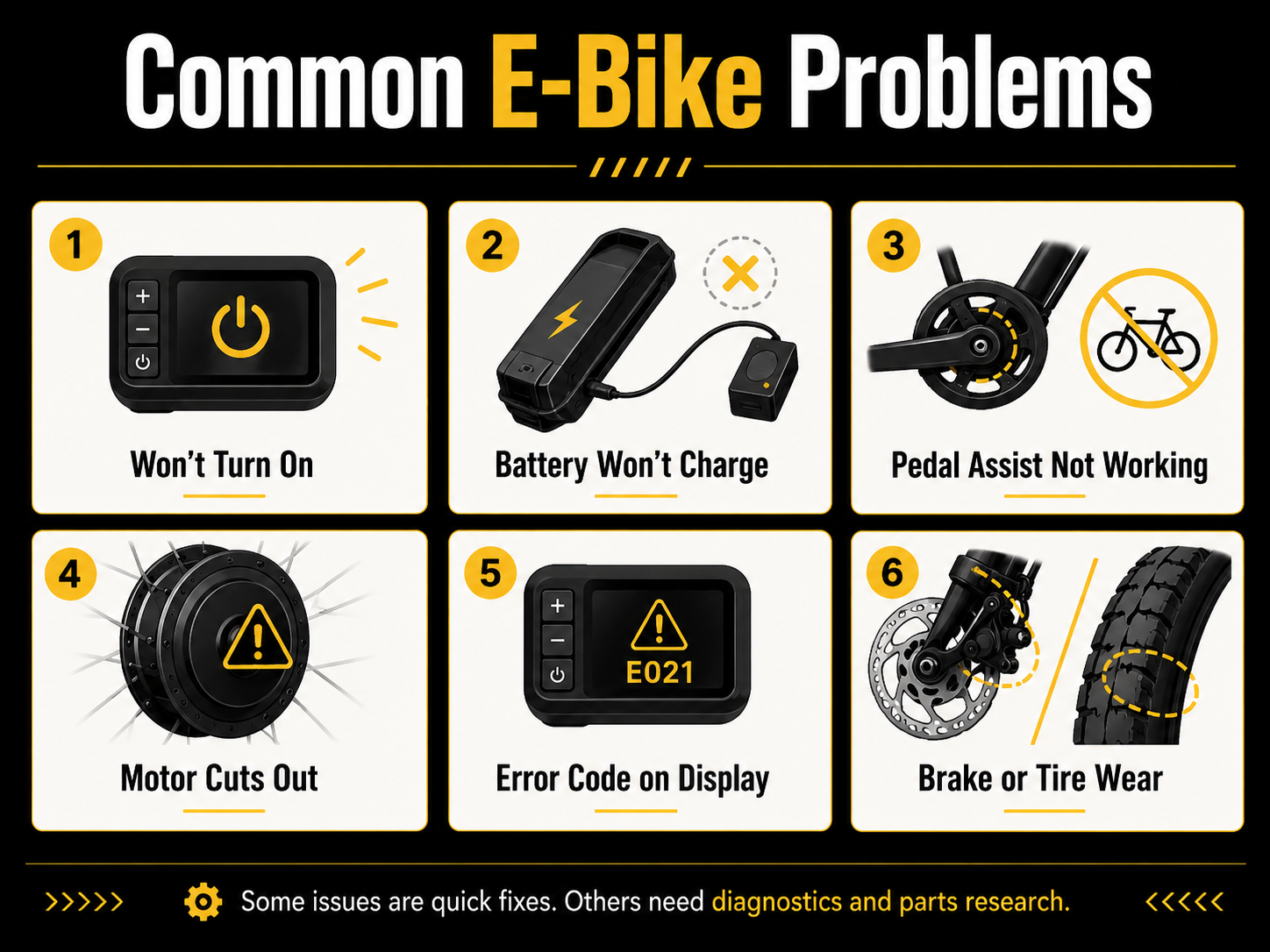
E-bike problems can be mechanical, electrical, or both. Some common issues include:
The e-bike will not turn on
The battery will not charge
The charger light behaves strangely
Pedal assist does not work
The throttle works but pedal assist does not
The display shows an error code
The motor cuts out while riding
The bike loses power over bumps
The battery range suddenly drops
The brake sensor keeps cutting motor power
The speed sensor is misaligned
The wiring harness is damaged
The controller fails
The bike has water damage
The motor makes grinding or clicking noises
The brakes, tires, chain, or drivetrain are worn
Some of these problems can be solved quickly. Others require more detailed testing, parts research, or communication with the manufacturer.
Why Some E-Bike Repairs Take Longer
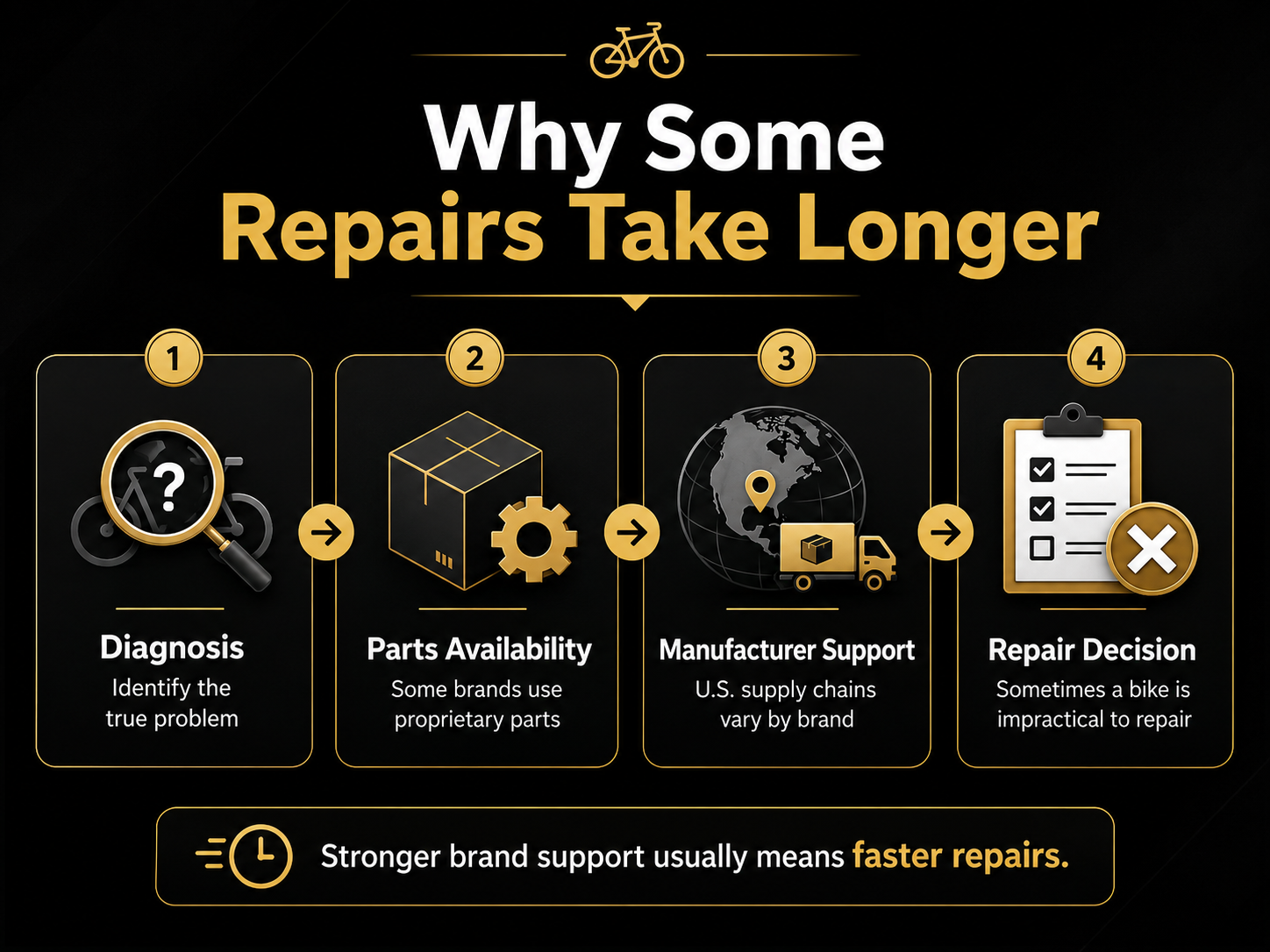
One of the biggest differences between e-bike repair and normal bike repair is parts availability.
For a traditional bicycle, many parts are standardized. Tires, tubes, brake pads, chains, cassettes, cables, rotors, saddles, and grips are often available through established bicycle distributors.
E-bikes are different. Many electrical parts are brand-specific or system-specific. A battery, controller, display, motor cable, charger, sensor, or wiring harness from one brand may not work on another brand. Even within the same brand, parts may vary by model year, voltage, connector type, firmware, display protocol, or controller design.
If an e-bike brand has a strong U.S. supply chain, good documentation, available replacement parts, and responsive technical support, the repair process is usually much smoother. If the brand does not have reliable U.S. support, the repair may take much longer.
In some cases, the shop may have to wait for the manufacturer to respond, search for a compatible part, confirm wiring diagrams, or determine whether a replacement component even exists. If the brand no longer supports the model, does not sell parts to shops, uses proprietary components, or cannot provide service information, the bike may become difficult or even impractical to repair.
This does not always mean the e-bike is impossible to fix. But it can mean the repair takes longer, costs more, or depends heavily on whether the brand can supply the correct parts.
Why Some E-Bikes May Be Unrepairable
Most e-bikes can be evaluated, but not every e-bike can be fully repaired.
An e-bike may become impractical to repair when:
The manufacturer does not provide replacement parts
The company no longer exists
The battery is discontinued
The controller is proprietary and unavailable
The display only works with a specific controller
The wiring harness is not documented
The motor is not serviceable
The bike has unsafe battery damage
The electrical system has been modified
The cost of repair exceeds the value of the bike
The bike does not meet basic safety standards
The bike does not clearly fit legal e-bike classifications
This is especially common with some low-cost online e-bikes. The purchase price may look attractive at first, but if the bike uses nonstandard electronics or has no reliable parts pipeline in the U.S., it may become much harder to repair later.
That is why we recommend asking about service before buying an e-bike, not after something breaks.
Battery Safety Is a Major Part of E-Bike Service
E-bike batteries are powerful lithium-ion battery packs. When they are well designed, properly charged, and safely maintained, they can be reliable and convenient. But damaged, modified, water-exposed, swollen, or poorly manufactured batteries can create serious safety risks.
Battery issues should be taken seriously. Stop riding or charging the bike and contact a professional if you notice:
Burning smell
Smoke
Swelling
Cracked battery case
Melted connector
Exposed wires
Water inside the battery or battery mount
Battery getting unusually hot
Charger sparking
Battery not locking securely
Sudden power cutoffs while riding
Do not continue charging a battery that appears damaged or behaves abnormally. Battery safety is one reason e-bike repair shops may need to inspect a bike carefully before agreeing to certain repairs.
Indiana E-Bike Classes Can Matter
Indiana recognizes Class 1, Class 2, and Class 3 e-bikes. These classes are based on motor wattage, whether the bike uses pedal assist or throttle, and the maximum assisted speed.
This matters because not every product sold online as an “e-bike” fits cleanly into these categories. Some vehicles look like bicycles but may have higher speeds, higher power levels, or components that make them closer to mopeds or motor vehicles.
For repair shops, this can create safety, liability, and parts concerns. A bike that does not fit normal e-bike standards may require parts or service procedures outside the bicycle industry. This can make diagnosis harder and may limit what a standard e-bike shop can safely repair.
Why Buying From a Local E-Bike Shop Helps
When you buy from a local e-bike shop, you are not only buying the bike. You are also buying access to support.
A good local shop can help with:
Test rides before purchase
Correct frame style and size
Comfort and fit adjustments
Battery and charger education
Brake and tire maintenance
Software or system support when available
Warranty guidance
Replacement part sourcing
Long-term service planning
This is especially important for riders who want to keep their e-bike for years. A quality e-bike from a reputable brand may cost more upfront, but it is usually easier to support over time if the brand has parts availability, technical documentation, dealer support, and a stable service network.
What to Bring When You Need E-Bike Repair
To help speed up the diagnostic process, bring as much information as possible:
The e-bike
The battery
The charger
The key, if the battery uses one
Any display or remote
A photo or note of the error code
The brand and model
Approximate purchase date
Any recent crash, water exposure, or wiring damage
A clear description of when the issue happens
For example, “the motor cuts out after five minutes,” “the battery only charges to one bar,” or “pedal assist stopped working after the rear wheel was removed” is much more helpful than simply saying “it does not work.”
When to Stop Riding Immediately
Some problems should not wait. Stop riding and schedule service if you notice:
Brake failure
Loose wheel
Cracked frame
Burning smell
Swollen battery
Exposed wiring
Motor grinding
Sudden power loss in traffic
Battery falling out of the mount
Charger overheating
Repeated electrical cutouts
Error codes that keep returning
An e-bike is heavier and faster than a normal bike, so small issues can become safety concerns quickly.
Final Thoughts: Serviceability Should Be Part of the Buying Decision
When shopping for an e-bike, it is easy to compare speed, range, battery size, and price. But serviceability matters just as much.
Before buying, ask:
Can this bike be serviced locally?
Does the brand have U.S. parts support?
Are batteries, chargers, displays, controllers, and sensors available?
Does the brand provide technical documentation?
Can a local shop get replacement parts?
Is the electrical system certified or safety-tested?
Will the bike still be supportable several years from now?
At Future Velo in Carmel, Indiana, we help riders choose, maintain, diagnose, and repair e-bikes with long-term support in mind. Whether you purchased your e-bike from us or elsewhere, we can help evaluate the bike, explain the repair process, and determine the best next step based on safety, parts availability, and serviceability.
If you need e-bike repair near Carmel, Indianapolis, Westfield, Fishers, Noblesville, or Hamilton County, contact Future Velo or visit our shop to schedule an e-bike diagnostic.