

E-Bike Battery Care in Indiana: How to Store, Charge, and Protect Your Battery
Indiana weather can be tough on e-bike batteries. In the Carmel and Indianapolis area, riders deal with cold winter mornings, humid summers, spring rain, fall temperature swings, and garages that can become either freezing cold or extremely hot depending on the season.
Because the battery is one of the most expensive and safety-sensitive parts of an e-bike, proper care matters. Good battery habits can help preserve range, reduce long-term wear, and prevent unsafe situations. Whether you ride a comfort e-bike, commuter e-bike, cargo e-bike, or folding e-bike, the way you store and charge the battery has a major effect on long-term ownership.
Why Indiana Weather Matters for E-Bike Batteries
E-bike batteries are lithium-ion battery packs. Like phone, laptop, and electric vehicle batteries, they are sensitive to extreme temperatures.
In central Indiana, winter temperatures often drop below freezing, especially during December, January, and February. Summer weather can also create problems, especially when an e-bike or battery is left in a hot garage, parked car, shed, or direct sunlight.
That means Indiana riders should not treat battery storage as an afterthought. The best place for most e-bike batteries is not a freezing garage in January or a hot shed in July. A controlled indoor space is usually better.
Ideal E-Bike Battery Storage Conditions
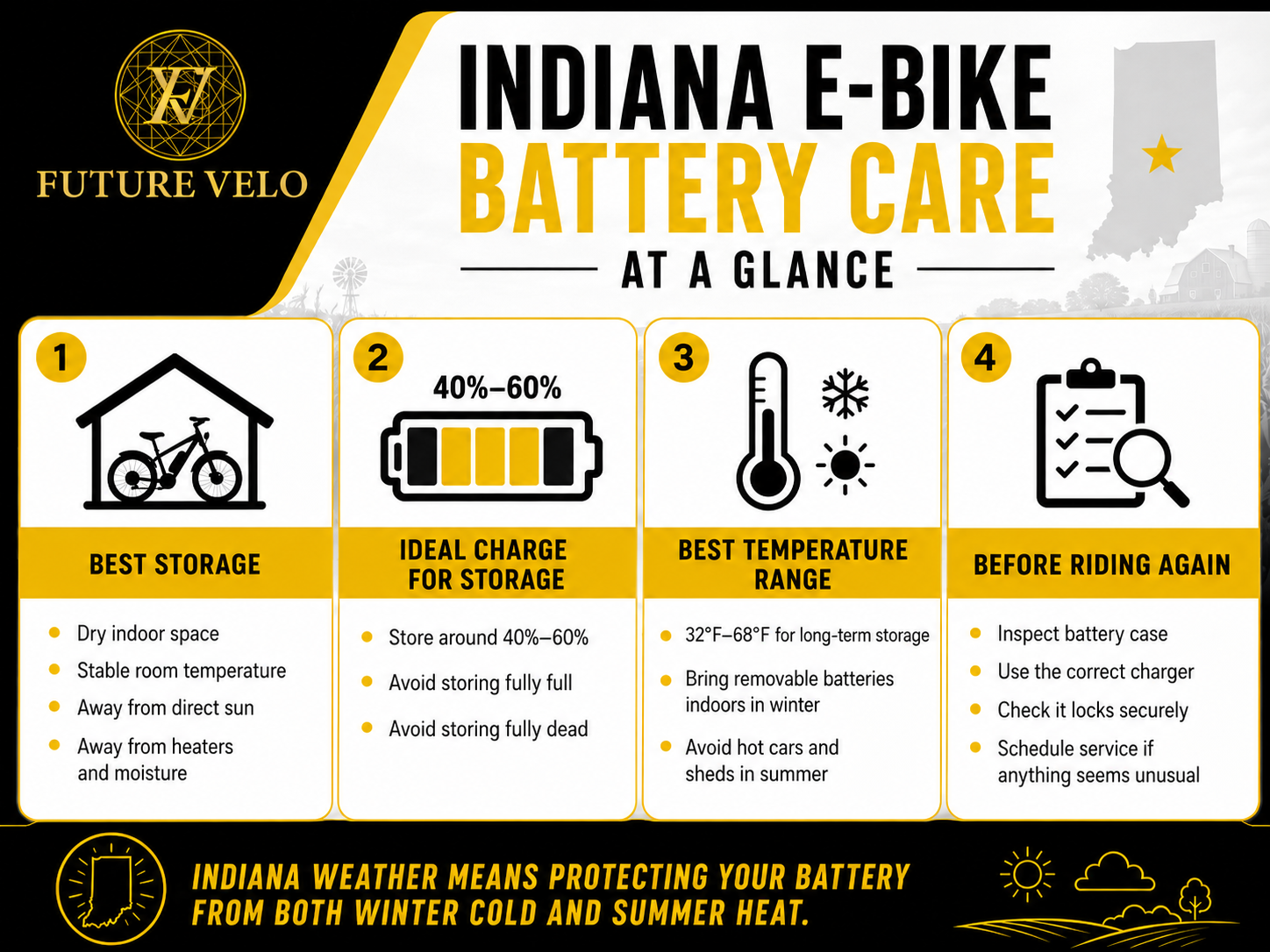
For long-term storage, the best conditions are:
Dry indoor location
Stable room temperature
Away from direct sunlight
Away from heaters, furnaces, or fireplaces
Away from water, flooding, or high humidity
Away from flammable materials
Not blocking doors, exits, or stairs
Stored with a partial charge, not completely full or completely empty
A good practical target is to store the battery around 40% to 60% charge. For many riders, about half charge is ideal for winter storage or any storage period longer than a few weeks.
As a general guideline, avoid storing the battery at 100% for long periods, and do not store it completely dead. A fully charged battery is under more stress during long storage, while a fully drained battery can fall too low and become difficult or impossible to recover.
Best Temperature Range for Storage
For many premium e-bike batteries, a good long-term storage range is approximately 32°F to 68°F in a dry environment. In everyday terms, that means a clean indoor room, closet, mudroom, office, or temperature-controlled storage area is usually better than an unheated garage or outdoor shed.
For Indiana riders, this matters most during:
January and February cold snaps
Overnight freezing temperatures
Summer heat waves
Hot garages and sheds
Long periods when the bike is not being used
If you store the bike in the garage, consider removing the battery and bringing only the battery indoors. This is especially helpful for removable batteries on commuter, comfort, and cargo e-bikes.
Winter Battery Care in Indiana
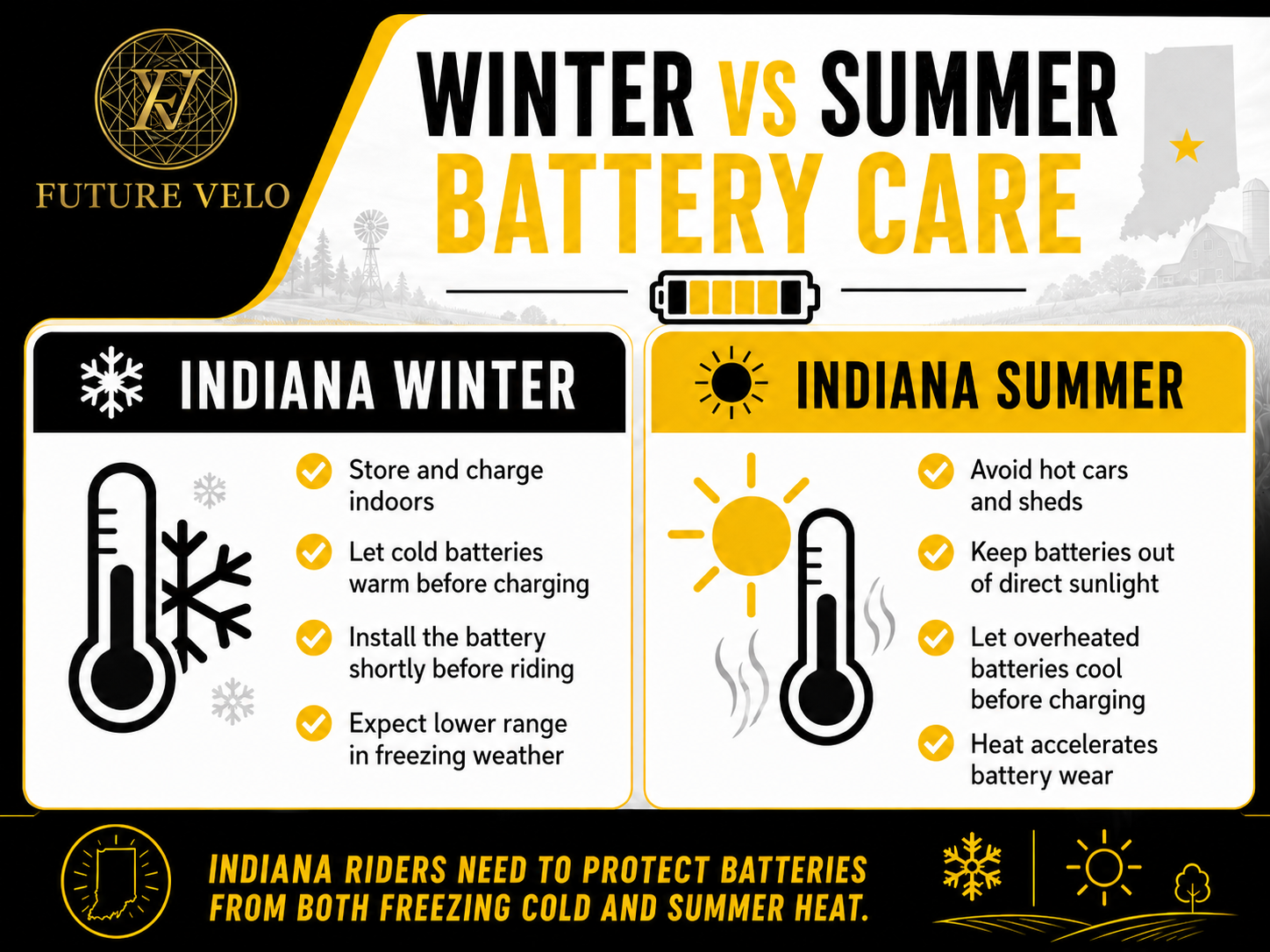
Cold weather can temporarily reduce range. This does not always mean the battery is damaged; it often means the battery is cold and cannot deliver energy as efficiently.
During Indiana winter riding, follow these habits:
Install the battery shortly before riding.
Avoid charging a battery while it is extremely cold.
Let the battery warm up indoors before charging.
Expect lower range in cold weather.
Use lower assist levels when possible to conserve power.
Avoid leaving the battery outside overnight.
For example, if your e-bike has been sitting in a freezing garage, do not immediately plug in the cold battery. Bring it inside, let it warm closer to room temperature, and then charge it.
This is especially important for riders who use their e-bike for winter commuting, short errands, or garage storage.
Summer Battery Care in Indiana
Indiana summers can be hot and humid. Even if the outdoor temperature is in the 80s or 90s, the inside of a garage, shed, or car can become much hotter.
During summer, avoid:
Leaving the battery in a hot car
Charging in direct sunlight
Storing the battery in a hot shed
Charging immediately after the battery has been sitting in extreme heat
Leaving the bike parked in direct sun for long periods when avoidable
If the battery feels unusually hot, let it cool before charging or riding. Heat accelerates battery wear and can increase safety risks, especially if the battery is damaged or poorly manufactured.
Safe Charging Habits
Charging habits are one of the most important parts of e-bike battery care.
Use these rules:
Use the charger designed for your exact battery.
Do not use random or cheap replacement chargers.
Do not charge a damaged battery.
Do not charge a swollen battery.
Do not charge a battery that smells strange, smokes, leaks, or makes unusual noises.
Do not charge near flammable materials.
Do not charge in a location that blocks an exit.
Avoid charging in extreme cold or extreme heat.
Unplug the charger once charging is complete.
Keep the battery and charger dry.
A battery that behaves abnormally should be inspected by a professional. Do not keep testing it at home to “see if it works.”
Why Opening an E-Bike Battery Is Dangerous
Customers sometimes ask whether an e-bike battery can be opened and repaired by replacing individual cells. In most normal shop situations, the answer is no.
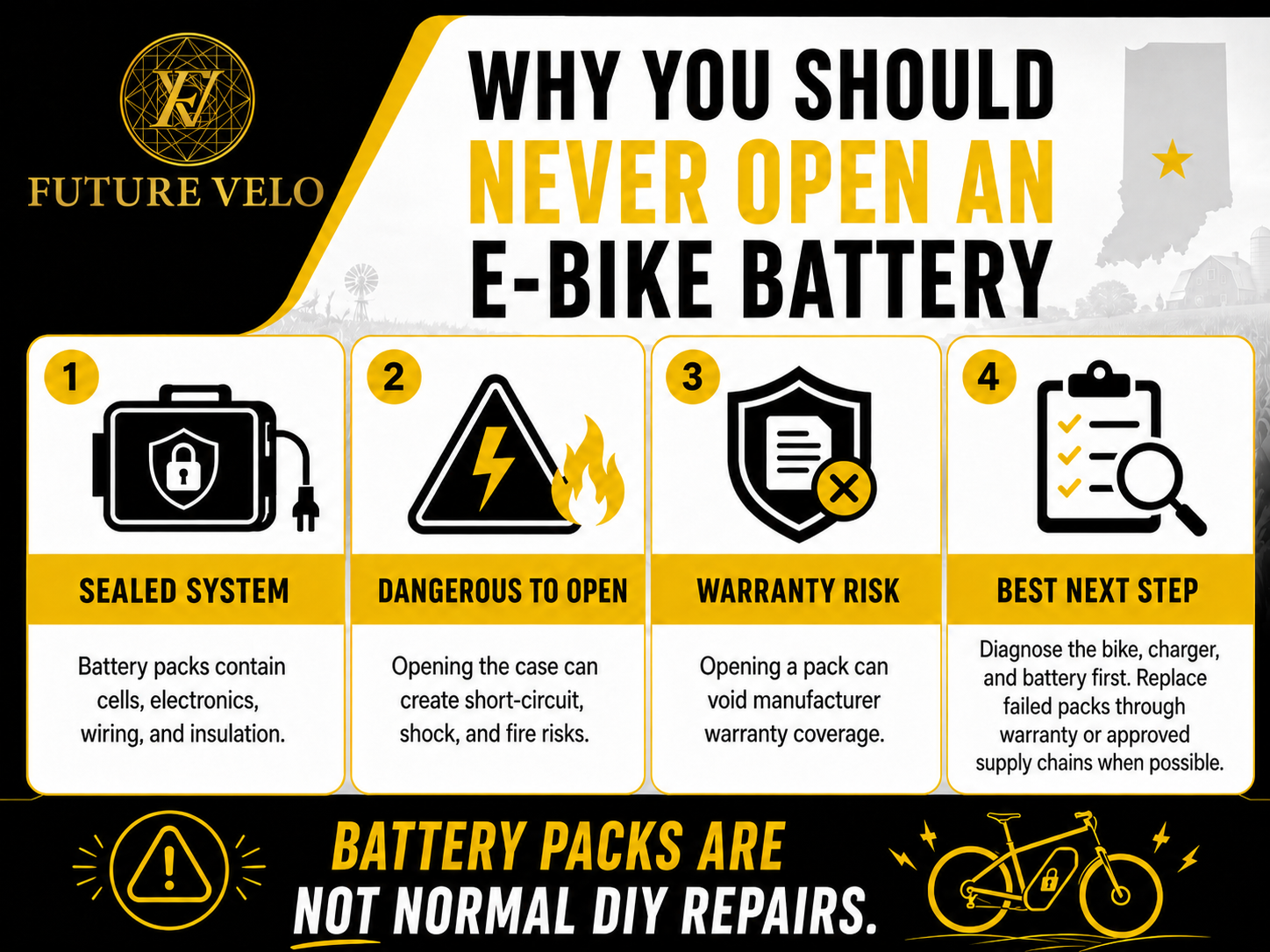
E-bike batteries are sealed electrical systems. Inside the case are individual lithium-ion cells, welded electrical connections, battery management electronics, wiring, insulation, and safety systems. Famous E-bike company in Taiwan, Tern, mentions that opening the case can damage the pack, create short-circuit risks, expose unsafe components, and void manufacturer warranty coverage.
A battery pack is not like replacing a tube, tire, chain, brake pad, or cassette. Once the battery case is opened, the safety condition of the pack may no longer match the manufacturer’s approved design. That can create fire, shock, and liability concerns.
For this reason, many e-bike batteries are not considered repairable at the cell level by local bike shops. If a battery fails, the safer and more professional solution is usually:
Diagnose the bike, charger, and battery connection.
Confirm whether the battery is actually the problem.
Check whether the battery is covered under manufacturer warranty.
Replace the battery through the manufacturer or authorized supply chain when possible.
Why Warranty Replacement Is Usually Better Than Battery Cell Repair
If a battery has an internal failure and is still under warranty, the best path is usually a manufacturer warranty claim rather than opening the pack. For example, Gazelle E-bikes are offered a two-year manufacturer warranty on the batteries.
Warranty replacement is better because:
The replacement battery comes from the manufacturer’s approved supply chain.
The battery case, electronics, and cells remain factory-built.
The replacement is designed to match the bike’s system.
The shop avoids unsafe cell-level repair.
The customer keeps the bike within the manufacturer’s service process.
The result is more reliable and easier to support long-term.
This is one reason buying from a reputable e-bike brand matters. Better brands usually have better documentation, safer battery systems, clearer warranty policies, and more reliable replacement part availability.
When a Battery May Need Professional Evaluation
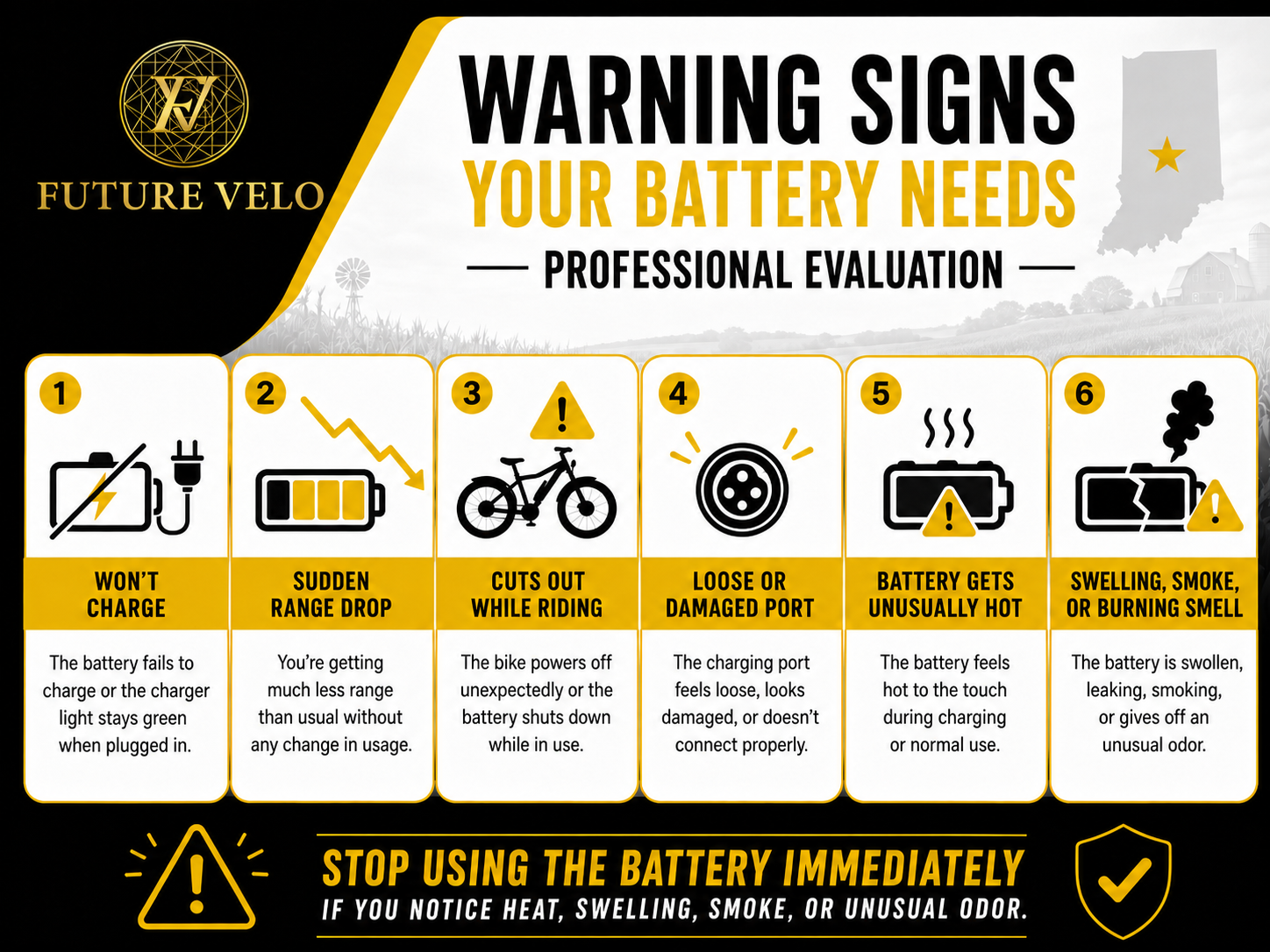
Bring your e-bike, battery, and charger in for inspection if you notice:
Battery will not charge
Charger light acts strangely
Battery range suddenly drops
Battery turns off under load
Bike cuts out while riding
Battery does not lock into the bike securely
Charging port is loose or damaged
Battery case is cracked
Battery has been dropped or crashed
Battery has been exposed to heavy water intrusion
Battery becomes unusually hot
Battery swells, smells, leaks, smokes, or makes noise
Stop using the battery immediately if there are signs of swelling, smoke, burning smell, melted plastic, exposed wiring, or unusual heat.
Why Premium Battery Systems Matter
A quality e-bike battery is more than a box of cells. It is part of a full electrical system that includes the motor, charger, display, controller, wiring, sensors, and battery management electronics.
That is why certified electrical systems and reputable brands matter. A well-supported system is usually easier to diagnose, safer to charge, and easier to replace if something goes wrong.
Lower-cost online e-bikes may look attractive, but if the battery, charger, or controller is proprietary and the brand has weak U.S. parts support, replacement can be difficult. In some cases, a failed battery can make the whole bike impractical to repair.
Indiana E-Bike Battery Storage Checklist
Before winter storage:
Clean and dry the bike.
Remove the battery if possible.
Store the battery indoors.
Keep the battery around 40% to 60% charge.
Check the charge level occasionally.
Keep it away from extreme cold.
Keep it away from moisture and flammable materials.
Do not leave it fully dead all winter.
Before summer storage:
Avoid hot cars, sheds, and direct sunlight.
Do not charge immediately after extreme heat exposure.
Store in a cool, dry indoor space.
Keep it away from water, humidity, and flammable materials.
Check for swelling, cracks, or unusual heat.
Before riding again:
Inspect the battery case.
Confirm it locks securely into the bike.
Use the correct charger.
Check for error codes.
Make sure the bike powers on normally.
Schedule service if anything seems unusual.
Final Thoughts
E-bike battery care is especially important in Indiana because riders experience both freezing winters and hot, humid summers. The best rule is simple: avoid temperature extremes, store the battery partially charged, keep it dry, use the correct charger, and never open the battery pack.
If a battery fails, the safest next step is a professional diagnosis. In many cases, the best solution is not cell-level repair; it is warranty evaluation or manufacturer-approved replacement.
At Future Velo in Carmel, Indiana, we help riders inspect e-bike batteries, diagnose charging and range issues, and determine whether a battery problem should be handled through service, warranty, or replacement. If your e-bike battery is not charging, losing range, or showing warning signs, bring the bike, battery, and charger to our shop for an evaluation.