

E-Bike vs Regular Bike: What’s the Difference
For many riders, the first time seeing the price of an electric bike can be surprising. At first glance, an e-bike may look similar to a regular bicycle: two wheels, pedals, handlebars, brakes, gears, and a frame. So why does it cost more? What does the motor actually do? And is it still “real cycling”?
The simple answer is this: an e-bike is still a bicycle, but it adds an electric assist system that helps multiply the rider’s pedaling power. That extra system changes how the bike feels, what it can handle, how far people are willing to ride, and how practical it becomes for commuting, hills, cargo, errands, and everyday transportation.
What Is an E-Bike?
An electric bike, or e-bike, is a bicycle equipped with a motor, battery, controller, and sensors that help the rider while pedaling. Under U.S. federal law, a low-speed electric bicycle must have fully operable pedals, an electric motor of less than 750 watts, and a maximum motor-only speed below 20 mph on level ground under the federal test definition.
This distinction matters because a legal e-bike is not the same thing as an electric motorcycle or moped. A true e-bike keeps the bicycle format: you can pedal it, shift it, steer it, brake it, and ride it much like a regular bike. The difference is that the motor helps reduce the effort needed to accelerate, climb hills, fight wind, or carry extra weight.
Regular Bike vs. E-Bike: The Basic Difference
A regular bike is powered entirely by the rider. Every bit of speed comes from your legs, your fitness, your gearing, and the terrain. That makes traditional bikes lightweight, simple, efficient, and usually less expensive to maintain.
An e-bike adds an electric drive system. Most e-bike systems include a motor, battery, controller, display, and sensors that measure speed, cadence, or pedaling force. Trek describes e-bikes as bikes that “amplify your pedaling power” through an electric drive system, while REI notes that e-bikes use many of the same categories as regular bikes—commuter, mountain, road, cargo, cruiser, folding—but add motor assistance for more capability.
That means the main difference is not that an e-bike replaces pedaling. Instead, a good e-bike makes pedaling feel easier, smoother, and more useful in real-world situations.
How Pedal Assist Works
Most modern e-bikes use pedal assist, which means the motor helps only when the rider is pedaling. You choose an assist level—often something like Eco, Tour, Sport, or Turbo—and the bike adds more or less power depending on that setting.
On a low assist level, the bike may feel like a normal bike with a light tailwind. On a higher assist level, hills feel flatter, starts feel easier, and heavier loads become more manageable. This is why many new riders describe an e-bike as feeling like they suddenly have stronger legs.
Torque is especially important for climbing hills and carrying cargo. Bosch explains that torque, measured in newton-meters, affects how strongly the bike accelerates and how well it can move heavier loads or climb steep terrain.
The Three Main Classes of E-Bikes
In the United States, e-bikes are commonly divided into three classes. PeopleForBikes defines them this way: Class 1 provides pedal assist up to 20 mph, Class 2 can use a throttle up to 20 mph, and Class 3 provides pedal assist up to 28 mph. All three classes generally fall under the 750-watt motor limit used in U.S. e-bike regulation.
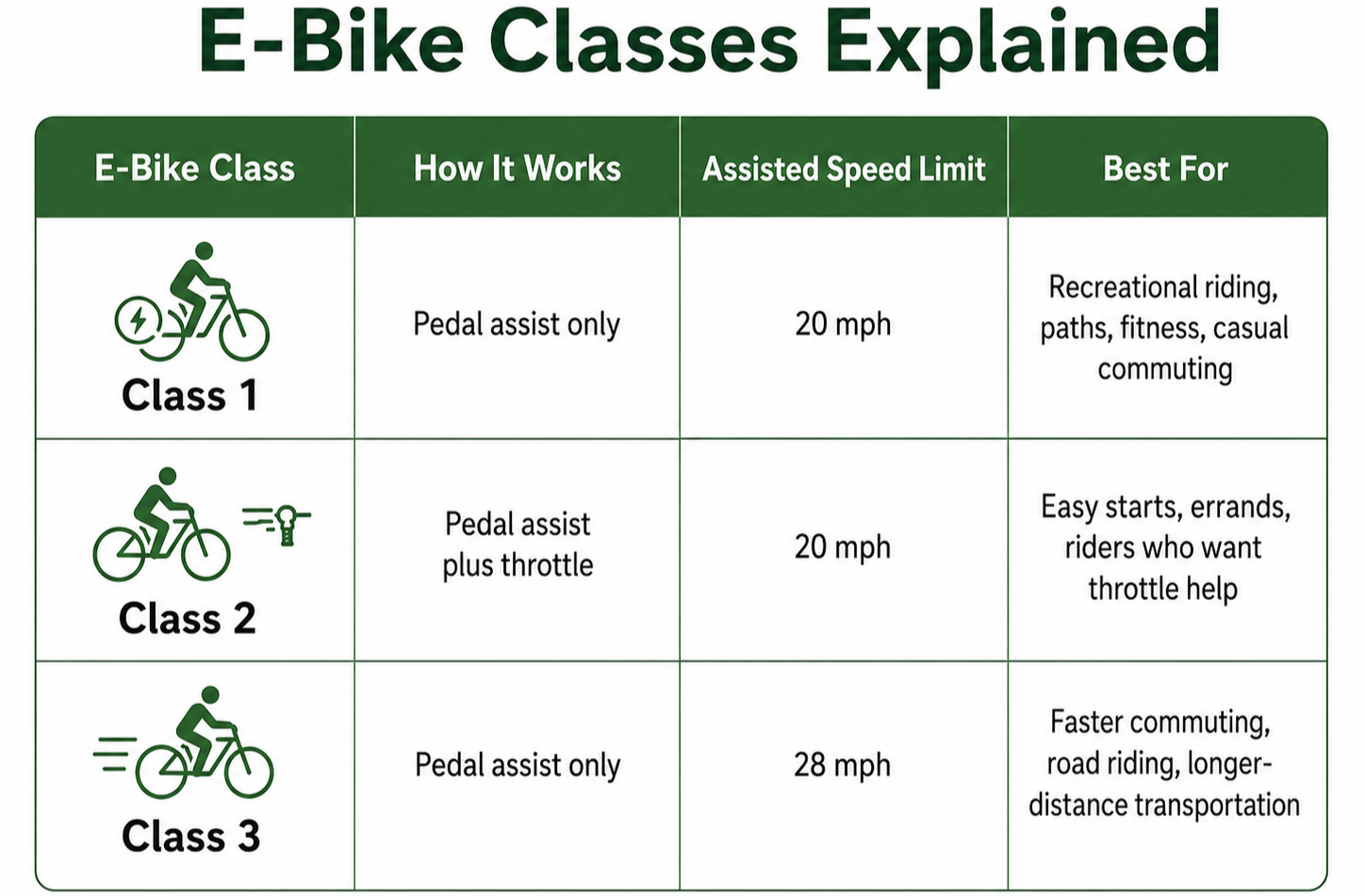
*Table of different classes of E-bikes
For Indiana riders, Class 3 e-bikes are also legally defined as bikes where the motor assists only while the rider is pedaling and stops assisting at 28 mph. Local trail and path rules can still vary, so riders should always check where each class is allowed before riding.
Why E-Bikes Feel Different From Regular Bikes
The biggest functional difference is accessibility. A regular bike may be perfect for short rides, fitness, and riders who enjoy doing all the work themselves. But hills, headwinds, long distances, knee pain, heavy cargo, or arriving sweaty can stop people from riding as often as they want.
An e-bike reduces those barriers. REI notes that pedal-assist e-bikes can help riders keep up in stop-and-start traffic, haul kids or cargo, arrive less sweaty, and ride routes that may otherwise feel too far or too hilly.
That is why e-bikes are especially useful for:
Commuting to work or school
Riding the Monon Trail or local paths with less fatigue
Keeping up with friends or family members
Carrying groceries, children, bags, or gear
Riding despite hills, wind, or lower fitness level
Replacing short car trips around Carmel, Westfield, and Indianapolis
A regular bike is mainly a fitness and recreation tool. An e-bike can still be used for fitness, but it also becomes a practical transportation tool.
Are E-Bikes Still Exercise?
Yes. E-bikes usually require less effort than a regular bike over the same route, but they can still provide meaningful physical activity.
A 2018 systematic review published in the International Journal of Behavioral Nutrition and Physical Activity found moderate evidence that e-cycling provides physical activity of at least moderate intensity. The review also found that e-biking intensity was generally lower than conventional cycling but higher than walking, and that e-bikes may improve cardiorespiratory fitness in physically inactive individuals.
Another study comparing e-bike users, conventional bike users, and non-cyclists across seven European cities found that e-bike riders often took longer trips and had similar weekly physical activity levels compared with conventional cyclists. The study reported that e-bike users averaged longer e-bike trips than conventional cyclists’ bike trips, helping explain why the lower effort per mile can still result in meaningful activity over time.
In other words, an e-bike is not “cheating.” It simply lets more people ride more often, ride farther, and choose a bike for trips they may otherwise take by car.
Why Do E-Bikes Cost More?
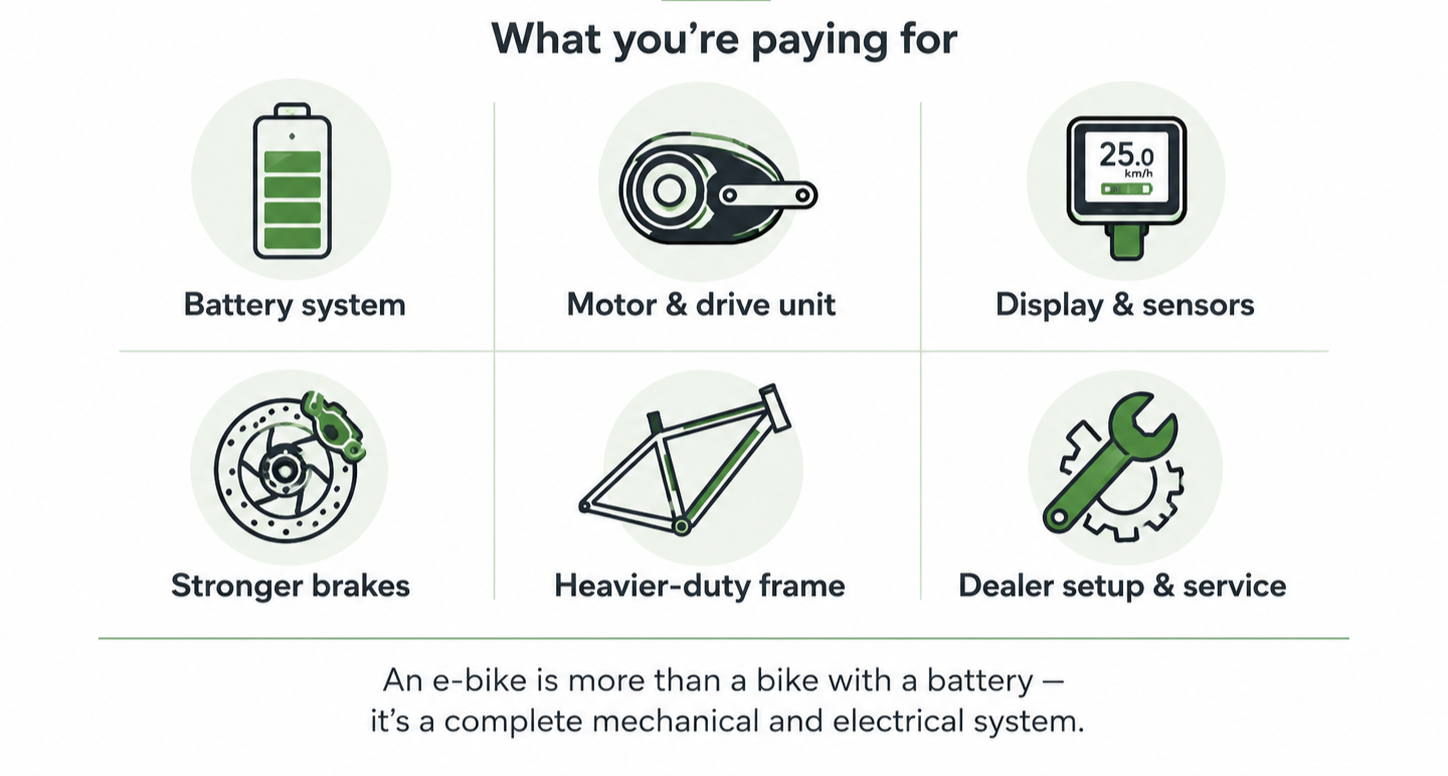
The price difference comes from the added technology and the stronger components needed to support it. A regular bike has a frame, drivetrain, wheels, brakes, and contact points. An e-bike has all of those parts plus an electric system.
The added cost usually includes:
The motor
The lithium-ion battery
The controller and display
Speed, cadence, or torque sensors
Integrated wiring
Stronger frame design
Higher-capacity brakes
Heavier-duty wheels and tires
Lighting, racks, fenders, or built-in accessories on many commuter models
Software, diagnostics, and brand support
The battery alone is a major part of the cost. Higher-quality e-bikes also usually use better braking systems, better drivetrains, safer electronics, and more reliable service support. That is especially important because an e-bike is heavier and faster than a regular bike, so braking, tires, and frame quality matter more.
Battery, Range, and Charging
A regular bike never needs charging. An e-bike does. That is one tradeoff.
Most e-bike batteries are measured in watt-hours, or Wh. A larger battery usually means more range, but range depends on many factors: rider weight, assist level, terrain, tire pressure, wind, temperature, cargo weight, and how often the bike stops and starts. REI notes that e-bike range estimates can vary widely because so many real-world variables affect battery usage.
For many local riders, the advantage is that an e-bike can usually be charged from a normal household outlet. The U.S. Department of Transportation notes that e-bikes can plug into a standard 120V outlet and can be useful for short trips, first-and-last-mile transportation, and local mobility.
Safety and Maintenance Differences
A regular bike mainly needs mechanical maintenance: tires, tubes, brakes, chains, gears, bearings, and cables. An e-bike needs those same services plus attention to the electrical system.
That does not mean e-bikes are unreliable, but it does mean quality and proper service matter. Riders should use the correct charger, avoid damaged batteries, follow the manufacturer’s charging instructions, and avoid cheap “universal” chargers. The U.S. Consumer Product Safety Commission warns consumers to follow manufacturer instructions, be present while charging, avoid charging while sleeping, and use only chargers and replacement batteries approved for the device.
Certification also matters. UL Solutions explains that UL 2849 evaluates the electrical drive train, battery system, and charger system combination for e-bike electrical and fire safety. This is one reason buying from a reputable brand and a local shop can be safer than buying an unknown online e-bike with limited documentation or service support.
Which One Should You Choose?
A regular bike may be the best choice if you want the lightest, simplest, least expensive option and you enjoy doing all the work yourself. It is great for fitness rides, casual neighborhood trips, and riders who value simplicity.
An e-bike may be the better choice if you want to ride farther, climb easier, carry more, commute faster, or replace more short car trips. It is especially helpful for riders who want the benefits of cycling but need extra support for hills, distance, cargo, or comfort.
The best way to understand the difference is to test ride one. On paper, an e-bike sounds like a bike with a motor. On the road, it often feels more like a regular bike that removes the hardest parts of riding.
Final Thought
E-bikes do not replace regular bikes. They expand what a bicycle can do.
A regular bike is simple, efficient, and fully human-powered. An e-bike keeps the bicycle experience but adds assistance that makes riding more practical for more people. For many customers, the higher price is not just for a motor—it is for a complete system that adds range, climbing ability, cargo capacity, commuting comfort, and everyday usefulness.
At Future Velo, we believe the best bike is the one that helps you ride more often. For some riders, that is a traditional bike. For others, an e-bike opens the door to rides, errands, commutes, and adventures that would not feel realistic otherwise. Book a consultation today to find your best fit!
Credible Sources:
International Journal of Behavioral Nutrition and Physical Activity — research review on e-bike use and physical activity
Cornell Legal Information Institute — U.S. federal definition of low-speed electric bicycles:
PeopleForBikes — explanation of Class 1, Class 2, and Class 3 e-bike categories:
Indiana Code via Justia — Indiana definition of Class 3 electric bicycles:
Bosch eBike Systems — explanation of e-bike drive systems, batteries, and motor support:
Trek Bikes — general e-bike FAQ and customer-friendly explanations of e-bike basics:
REI Co-op — consumer guide on choosing an e-bike:
Transportation Research Interdisciplinary Perspectives — study comparing physical activity from e-bike users and conventional cyclists:
U.S. Department of Transportation — information on e-bikes and local transportation benefits:
U.S. Consumer Product Safety Commission — micromobility and lithium-ion battery safety guidance:
UL Solutions — UL 2849 e-bike electrical system safety certification information: