

Indiana E-Bike Laws Explained: What Riders Need to Know in Hamilton County and Indianapolis
E-bikes are becoming more common across Indiana, especially in places like Carmel, Fishers, Westfield, Noblesville, and Indianapolis. They are useful for commuting, trail riding, errands, and short local trips. But as e-bikes, e-scooters, e-motos, and high-powered electric motorcycles become more popular, the rules can get confusing.
Not every electric two-wheel vehicle is legally an e-bike. Indiana law divides legal e-bikes into three classes, and the class of your e-bike affects where you can ride, how fast the motor can assist, whether a throttle is allowed, and what rules apply on trails.
This guide explains Indiana’s e-bike laws in plain language and how those rules affect riders around Hamilton County and Indianapolis.
Quick Answer: What Counts as an E-Bike in Indiana?
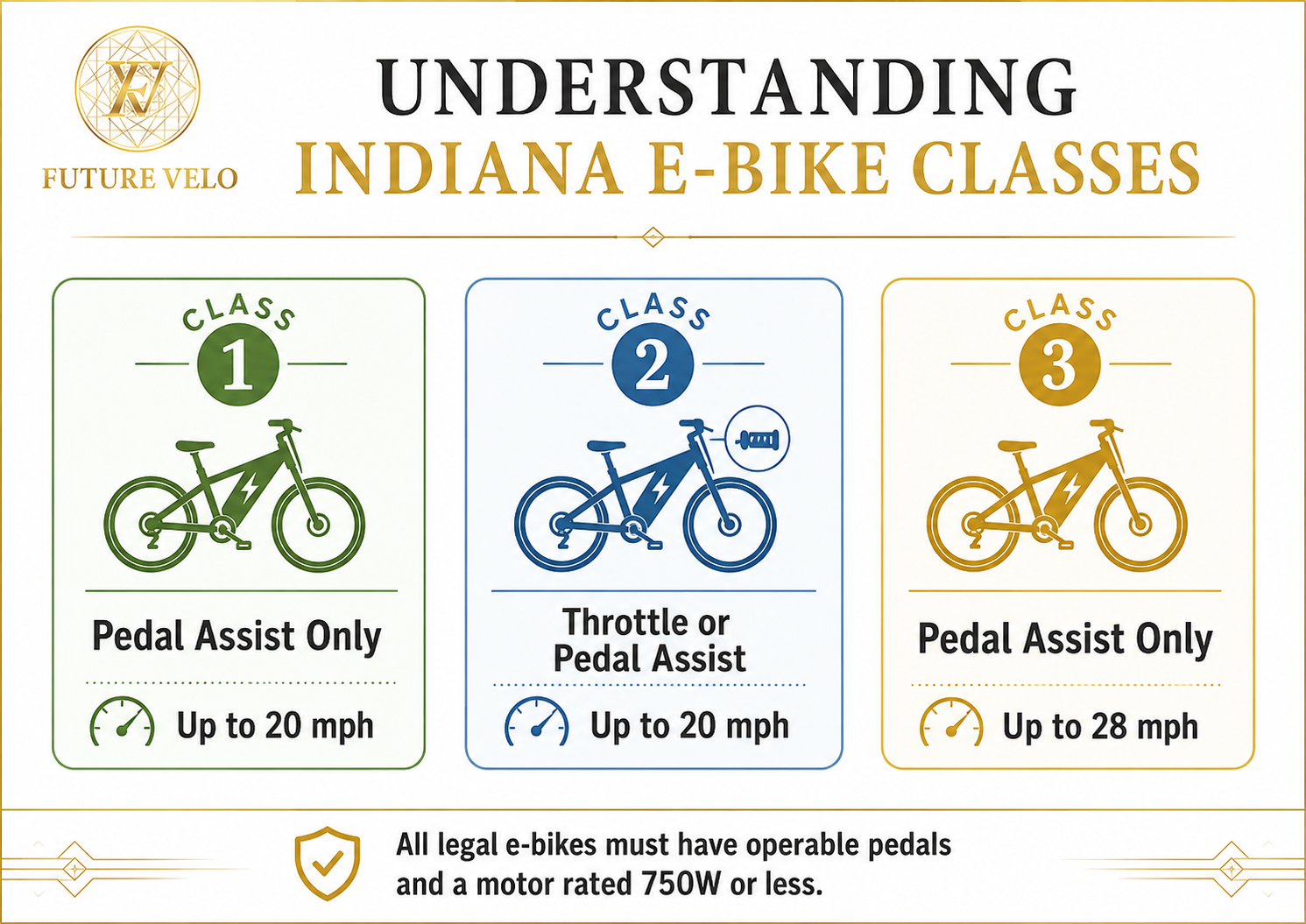
Indiana recognizes three main types of electric bicycles: Class 1, Class 2, and Class 3. To be eligible for Indiana’s e-bike system, the bike must have fully operable pedals and an electric motor that meets the state’s class definitions.
In simple terms:
Class 1: Pedal assist only, up to 20 mph.
Class 2: Throttle or pedal assist, up to 20 mph.
Class 3: Pedal assist only, up to 28 mph.
The motor limit is 750 watts or less. If an electric bike, scooter, dirt bike, or motorcycle does not fit one of Indiana’s e-bike definitions, it may be treated as a motorized vehicle instead of a bicycle.
That is one of the most important things for riders and parents to understand. A high-powered electric dirt bike without pedals is usually not the same thing as a legal e-bike.
Class 1 E-Bikes in Indiana
A Class 1 e-bike is pedal-assist only. The motor helps only when the rider is pedaling, and the assistance stops once the bike reaches 20 mph.
Class 1 e-bikes are usually the simplest option for trails, casual riding, neighborhood routes, and shared-use paths. Because there is no throttle, the bike feels closer to a traditional bicycle with electric assistance.
Best use cases for Class 1 e-bikes include:
Recreational trail riding
Neighborhood riding
Fitness riding
Casual commuting
Riders who want the most bicycle-like experience
Paths and greenways where lower-speed riding is expected
For many Indiana riders, Class 1 is the safest and least confusing e-bike class for shared-use paths.
Class 2 E-Bikes in Indiana
A Class 2 e-bike can use a throttle. This means the motor can move the bike without the rider pedaling, but motor assistance must stop at 20 mph.
Class 2 e-bikes are popular because the throttle can help riders start from a stop, get through intersections, or ride when they need a small boost. However, riders should understand that throttle use still has limits. A Class 2 e-bike is not supposed to keep providing motor power above 20 mph.
Best use cases for Class 2 e-bikes include:
Riders who want throttle support
Short local trips
Stop-and-go riding
Riders who need help getting started
Casual commuting
Neighborhood and path riding where permitted
Class 2 e-bikes are generally treated similarly to Class 1 e-bikes under Indiana’s path rules, unless a local rule says otherwise.
Class 3 E-Bikes in Indiana
A Class 3 e-bike is pedal-assist only, but the motor can assist up to 28 mph. Class 3 e-bikes do not use a throttle under Indiana’s class definition.
Class 3 e-bikes are often better for longer commuting, road riding, and riders who want to keep a faster pace. However, they are more restricted on bike paths and multipurpose paths than Class 1 and Class 2 e-bikes.
In Indiana, a person under 15 years old may not operate a Class 3 e-bike. Riders or passengers under 18 must wear a properly fitted and fastened bicycle helmet when using a Class 3 e-bike.
Best use cases for Class 3 e-bikes include:
Longer commutes
Road riding
Faster transportation routes
Experienced riders
Riders who need higher assisted speed on streets
Routes with bike lanes or road-adjacent paths
Class 3 e-bikes are not always the best choice for crowded trails, family greenways, or areas with heavy pedestrian traffic.
Do You Need a License, Registration, or Insurance for an E-Bike in Indiana?
For a properly classified e-bike, Indiana generally treats the e-bike more like a bicycle than a motor vehicle.
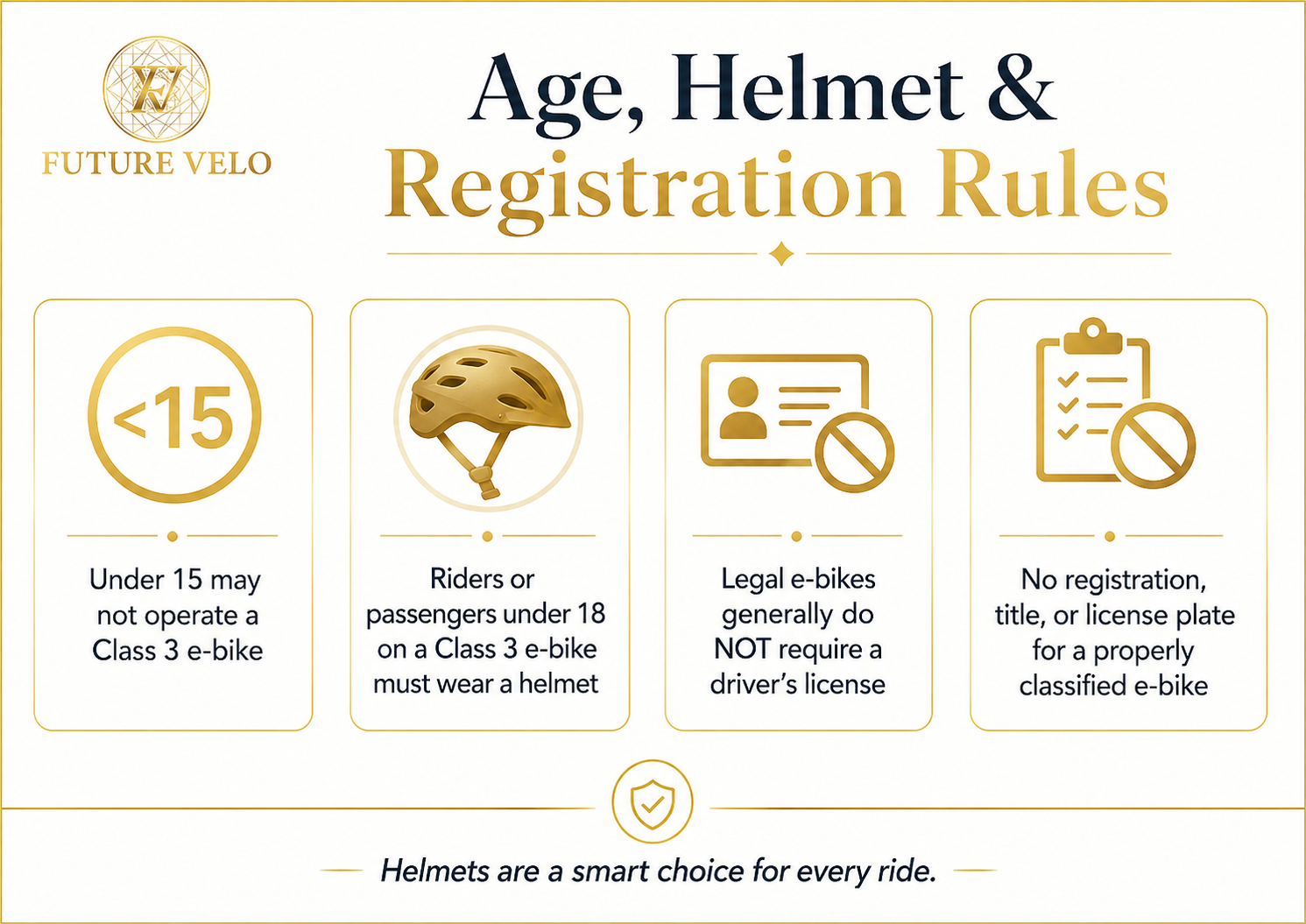
A legal e-bike is not treated as a motor vehicle under Indiana’s e-bike statute. E-bike operators are generally entitled to the rights and duties of bicycle operators. Indiana’s e-bike law also says e-bike riders are not subject to driver’s license requirements or financial responsibility requirements, and properly classified e-bikes are not subject to motor vehicle title or registration requirements.
In plain language, a compliant Class 1, Class 2, or Class 3 e-bike usually does not need:
Driver’s license
Motor vehicle registration
License plate
Motor vehicle title
Auto insurance
However, if the vehicle does not fit the legal e-bike definition, the situation changes. A high-powered electric motorcycle, e-moto, or modified electric bike may not receive the same treatment.
Why Labels and Modifications Matter
Indiana law requires e-bike manufacturers or distributors to provide a permanent label showing the bike’s class level, top assisted speed, and rated motor wattage.
This matters because the label helps riders, shops, police, trail managers, and parents understand what kind of vehicle it is.
Modifications also matter. If an e-bike is changed so that its assisted speed, motor engagement, or operating behavior no longer matches the original class, the label should be updated. More importantly, the bike may no longer fit the same legal category.
Examples of modifications that can create problems include:
Unlocking higher assisted speed
Installing a more powerful motor
Adding a throttle to a class where throttle use does not belong
Disabling speed limits
Replacing the controller with a higher-output controller
Turning a pedal-assist bike into a motor-only vehicle
A modified e-bike may become legally questionable, harder to service, harder to insure, and unsafe for trails.
The Big Difference Between E-Bikes and E-Motos
A lot of confusion comes from vehicles that look similar but are not legally the same.
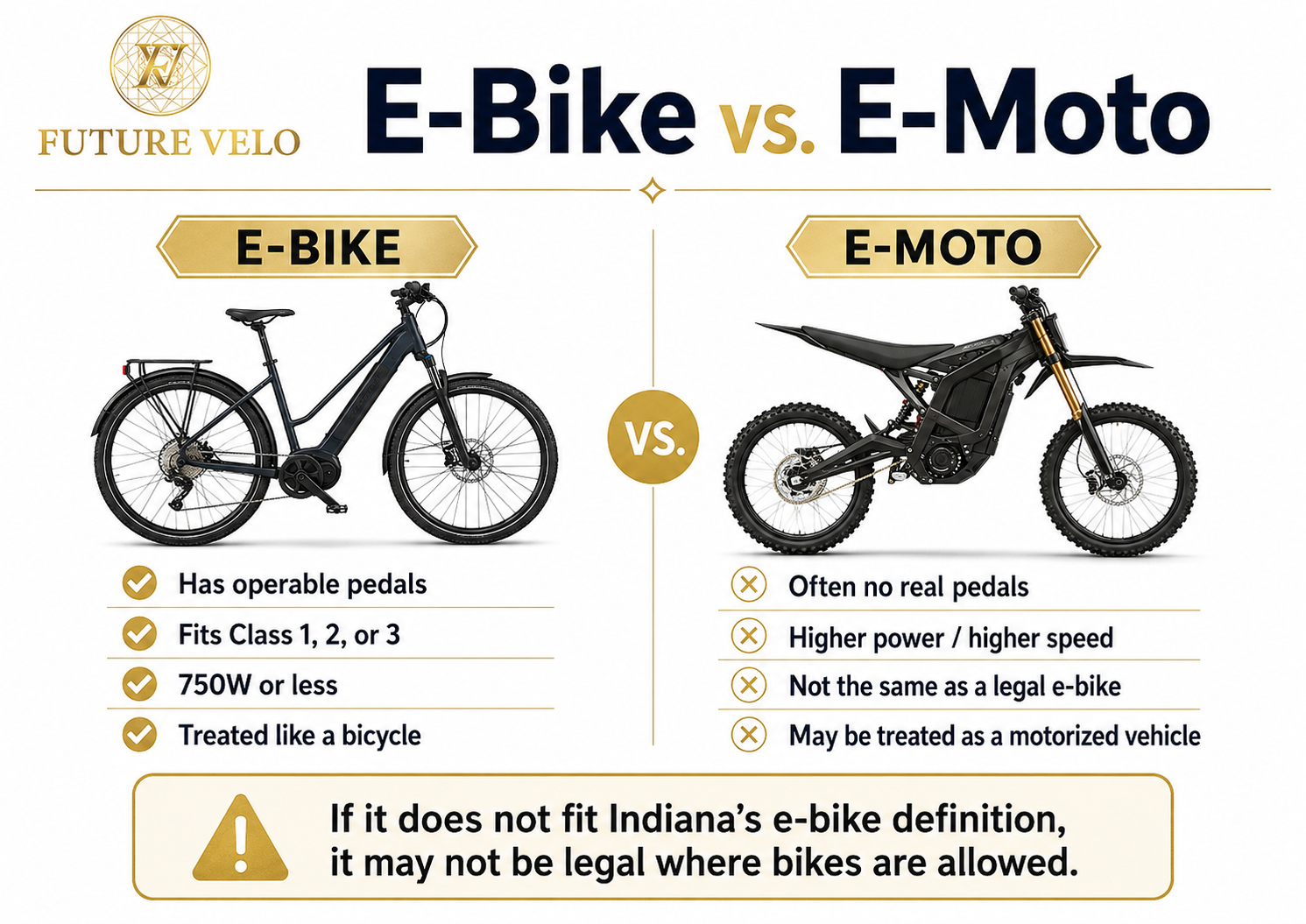
A legal e-bike has pedals and fits one of Indiana’s three e-bike classes. An e-moto or electric dirt bike may have much more power, higher speeds, no functional pedals, or motorcycle-style operation.
If the vehicle does not fit Indiana’s e-bike definition, it may be treated as a motorized vehicle. That means the rider may not be allowed to use bike paths, sidewalks, greenways, or trails the way a legal e-bike can.
This distinction matters especially for parents buying electric vehicles for teenagers. A product may be advertised online as an “electric bike,” but if it does not have pedals or exceeds Indiana’s e-bike class limits, it may not legally be an e-bike.
Before buying, check:
Does it have fully operable pedals?
What is the motor wattage?
What is the top assisted speed?
Does it have a throttle?
Does motor assistance stop at the required speed?
Does the bike have a class label?
Is it Class 1, Class 2, or Class 3?
Is it actually an e-moto or electric motorcycle?
Where Can You Ride an E-Bike in Indiana?
Statewide, Indiana generally allows e-bikes wherever bicycles are permitted, but there are important exceptions.
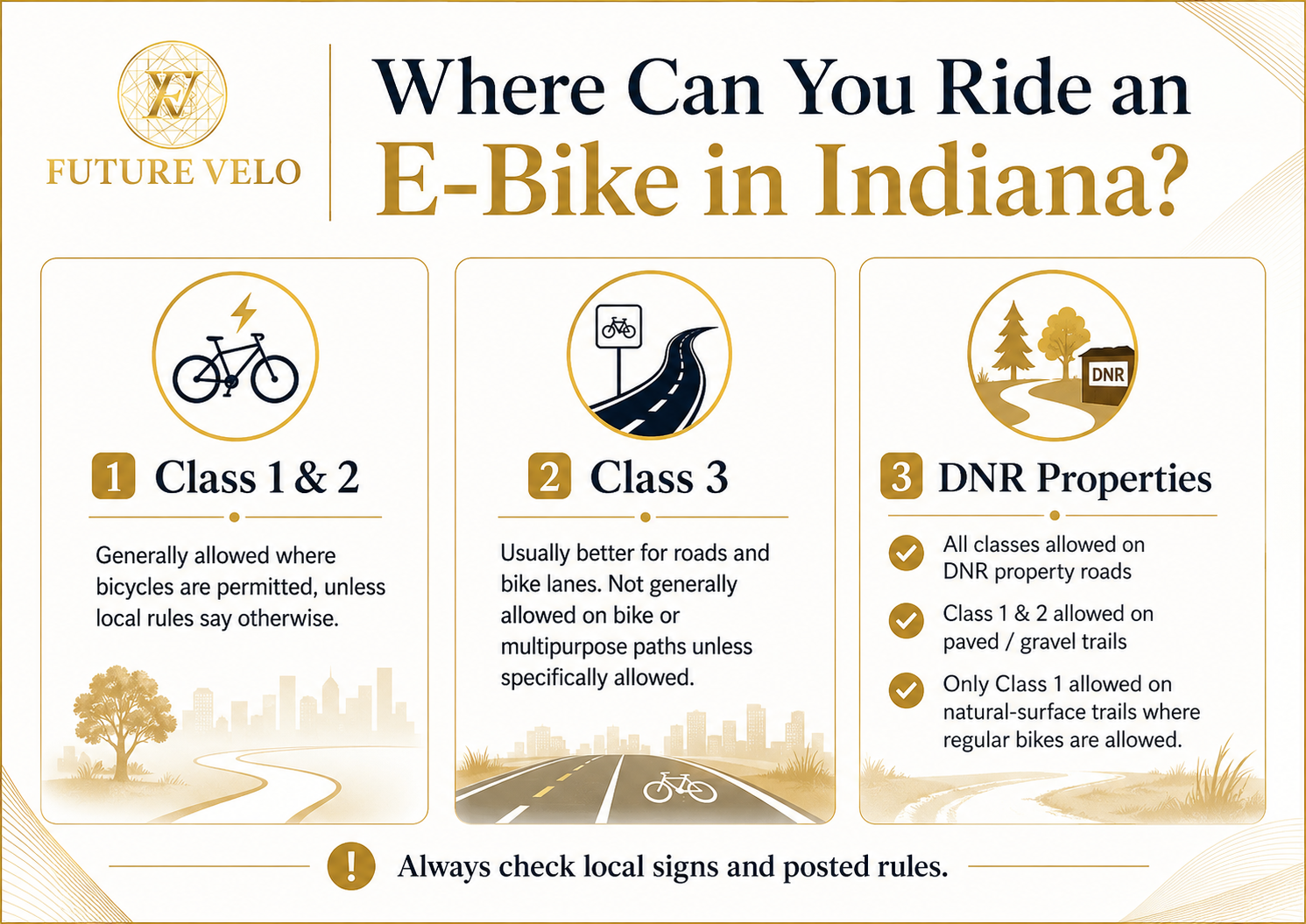
Class 1 and Class 2 e-bikes may generally be operated on bicycle paths or multipurpose paths where bicycles are permitted, unless a statute, rule, or local ordinance says otherwise.
Class 3 e-bikes are more limited. A Class 3 e-bike generally may not be operated on a bicycle path or multipurpose path unless the path is within or adjacent to a highway or roadway, or a local authority or state agency specifically allows Class 3 use.
This means the safest simple rule is:
Class 1 and Class 2 are usually better for trails and multipurpose paths.
Class 3 is usually better for roads, bike lanes, commuting, and routes where higher assisted speed is appropriate.
Always check local trail signs and city rules.
What About Indiana DNR Properties?
Indiana Department of Natural Resources rules are a little more specific.
On DNR property, all three e-bike classes are allowed on roads inside DNR properties, similar to regular non-motorized bicycles. On paved, concrete, or gravel trails, Class 1 and Class 2 e-bikes are allowed. On natural-surface trails where regular bicycles are allowed, only Class 1 e-bikes are allowed.
That means riders should be especially careful when moving from paved trails to natural-surface trails. A bike that is allowed on a road or paved path may not be allowed on every trail.
How Indiana E-Bike Laws Affect Hamilton County
The main point is that there is not just one simple “Hamilton County rule.” Riders need to understand both Indiana state law and the local rules of the city or trail they are using.
This is especially important because many trails cross city boundaries. A rider may start in Carmel, continue toward Westfield, pass into Fishers, or connect to Indianapolis-area routes. The legal treatment may change depending on the trail, city, posted signs, and e-bike class.
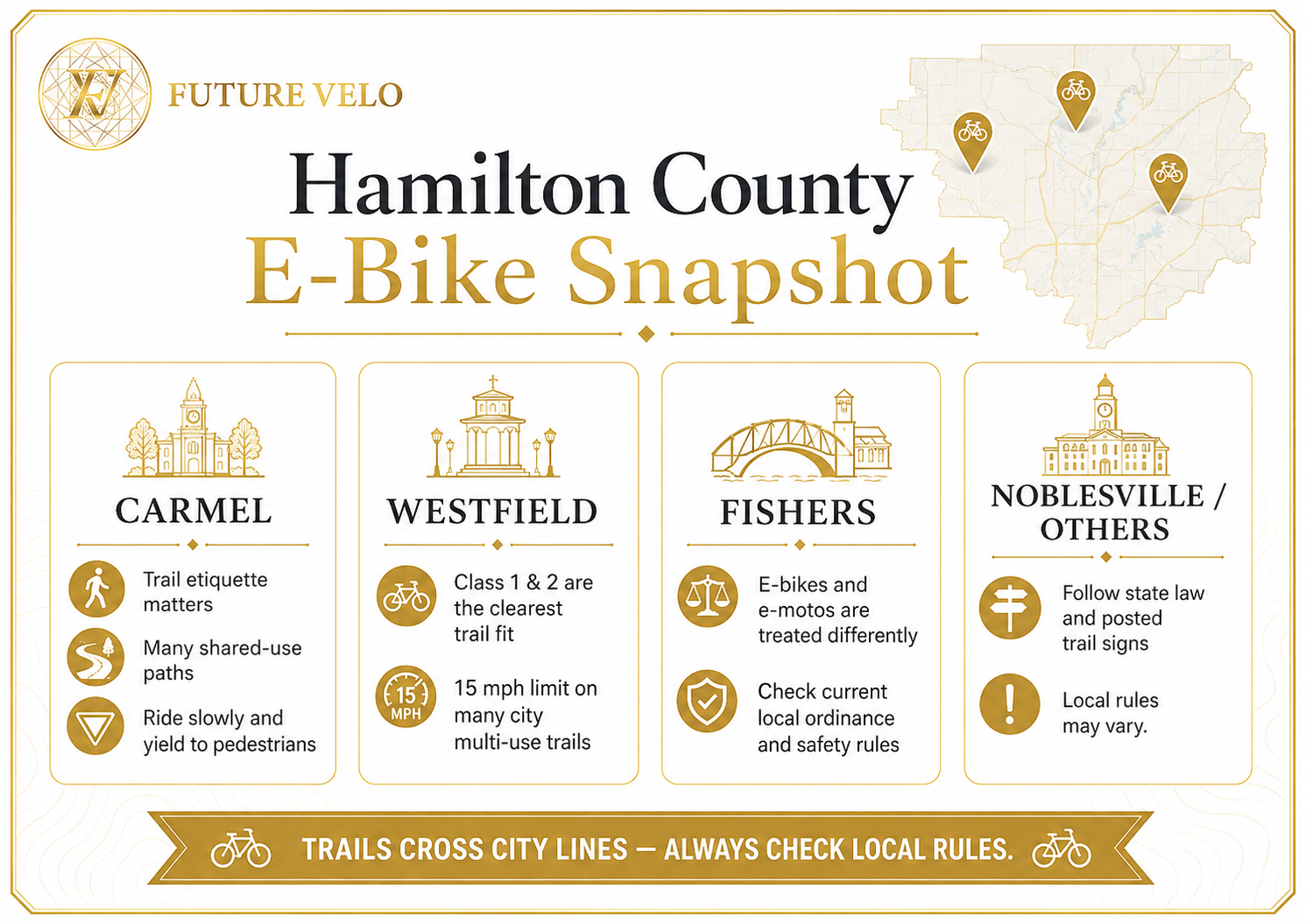
Carmel: Monon Greenway, Paths, and Shared Spaces
Carmel has a strong biking culture and a major trail network, including the Monon Greenway. Because of the number of pedestrians, children, cyclists, and families using the trails, speed and device type matter.
Carmel has warned that motor vehicles, motorized cycles, bicycles propelled solely by a motor, electric unicycles, and e-scooters are not permitted on trails and pathways. Carmel’s public guidance makes an exception for e-bikes and certain foot-powered devices that cannot exceed 20 mph.
Carmel Clay Parks & Recreation also lists important greenway rules. Bicycles must not exceed 15 mph or the posted speed limit, racing is prohibited, cyclists must yield to pedestrians, reckless use is prohibited, and motorized vehicles are not permitted on trails or park grounds.
For Carmel riders, the practical takeaway is:
Use Class 1 or Class 2 e-bikes for greenways and shared-use paths.
Keep speeds low, especially on the Monon.
Follow the 15 mph or posted speed limit.
Yield to pedestrians.
Avoid high-powered e-motos, electric dirt bikes, and motor-only devices on trails.
Treat Class 3 e-bikes carefully and check local rules before using them on paths.
Even if your e-bike can go faster, the trail environment may require slower, more cautious riding.
Westfield: Trails, Class 1 and Class 2, and Speed Limits
Westfield’s trail rules specifically permit Class 1 and Class 2 e-bikes within its definition of allowed exceptions to motorized vehicles. Westfield’s code defines Class 1 as pedal assist up to 20 mph and Class 2 as throttle-actuated assistance up to 20 mph.
Westfield also lists several multi-use trails, including the Monon Trail, Midland Trace Trail, Grand Junction Trail, Natalie Wheeler Trail, Monon Midland Loop Trail, Grassy Branch Trail, and Cool Creek Trail. Westfield’s rules set a 15 mph speed limit on multi-use trails, paths, and sidewalks.
For Westfield riders, the practical takeaway is:
Class 1 and Class 2 e-bikes are the clearest fit for city multi-use trails.
Class 3 riders should be careful and check whether the specific route allows Class 3 use.
Keep speed at or below 15 mph on city trails, paths, and sidewalks.
Yield properly and give an audible signal before passing.
Avoid reckless riding or racing.
Fishers: Newer Local Rules for E-Bikes, E-Motos, and Safety
Fishers has recently been more active in regulating e-bikes, e-scooters, and e-motos because of safety concerns on roads, sidewalks, and trails.
Recent reporting on Fishers’ updated ordinance says the city created updated definitions and operating rules for e-bikes, e-scooters, electric personal assistive mobility devices, and e-motos. The reported rules restrict e-motos to roadways, prohibit them from trails, sidewalks, and bike lanes, and allow e-bikes, including Class 3 e-bikes, to continue operating where bicycles are allowed.
The same reporting says Fishers added safety standards such as helmet requirements for younger riders, yielding to pedestrians, safe passing, and prohibitions on reckless behavior like wheelies, burnouts, unsafe passing, and weaving through traffic.
For Fishers riders, the practical takeaway is:
Legal e-bikes are treated differently from e-motos.
E-motos are much more restricted than e-bikes.
Reckless riding behavior is a major enforcement focus.
Riders should check Fishers’ current ordinance and police guidance before assuming a device is allowed everywhere.
Parents should be especially careful when buying high-powered electric vehicles for minors.
Because these rules are newer, riders should check the latest city code or Fishers Police guidance before relying on older information.
Noblesville and Other Hamilton County Areas
For Noblesville and other Hamilton County areas, riders should start with the Indiana statewide rules and then check local trail signs, park rules, and city guidance.
If a trail or park posts a specific e-bike rule, that rule matters. If a city limits a trail to Class 1 or Class 2 e-bikes, riders should follow that local rule even if the bike is legal on roads elsewhere.
For Noblesville-area riders, the practical takeaway is:
Use Class 1 or Class 2 for shared-use paths unless signs say otherwise.
Be cautious with Class 3 e-bikes on trails.
Follow posted trail speed limits.
Yield to pedestrians and slower users.
Check local guidance for parks, schools, and city trails.
How Indiana E-Bike Laws Affect Indianapolis
Indianapolis has a different e-bike environment from Hamilton County. There are more urban routes, downtown streets, the Monon Trail, the Indianapolis Cultural Trail, bike lanes, shared-use paths, and areas with heavier traffic.
For Indianapolis trail users, the clearest practical rule is that Class 1 and Class 2 e-bikes are generally the safest fit for trails where e-bikes are allowed. Indianapolis-area reporting based on IMPD guidance has listed Class 1 and Class 2 e-bikes as allowed on Indy trails, while Class 3 e-bikes, gas-powered vehicles, motorized scooters, mopeds, dirt bikes, and unauthorized motorized vehicles are not allowed on those trails.
The Indianapolis Cultural Trail is also a major downtown bicycle and pedestrian corridor. Its FAQ specifically recommends riding Pacers Bikeshare and notes that Pacers Bikeshare includes e-bikes, which shows that e-bikes are part of the downtown trail ecosystem. Still, riders should follow local trail rules, posted signs, speed expectations, and pedestrian-first etiquette.
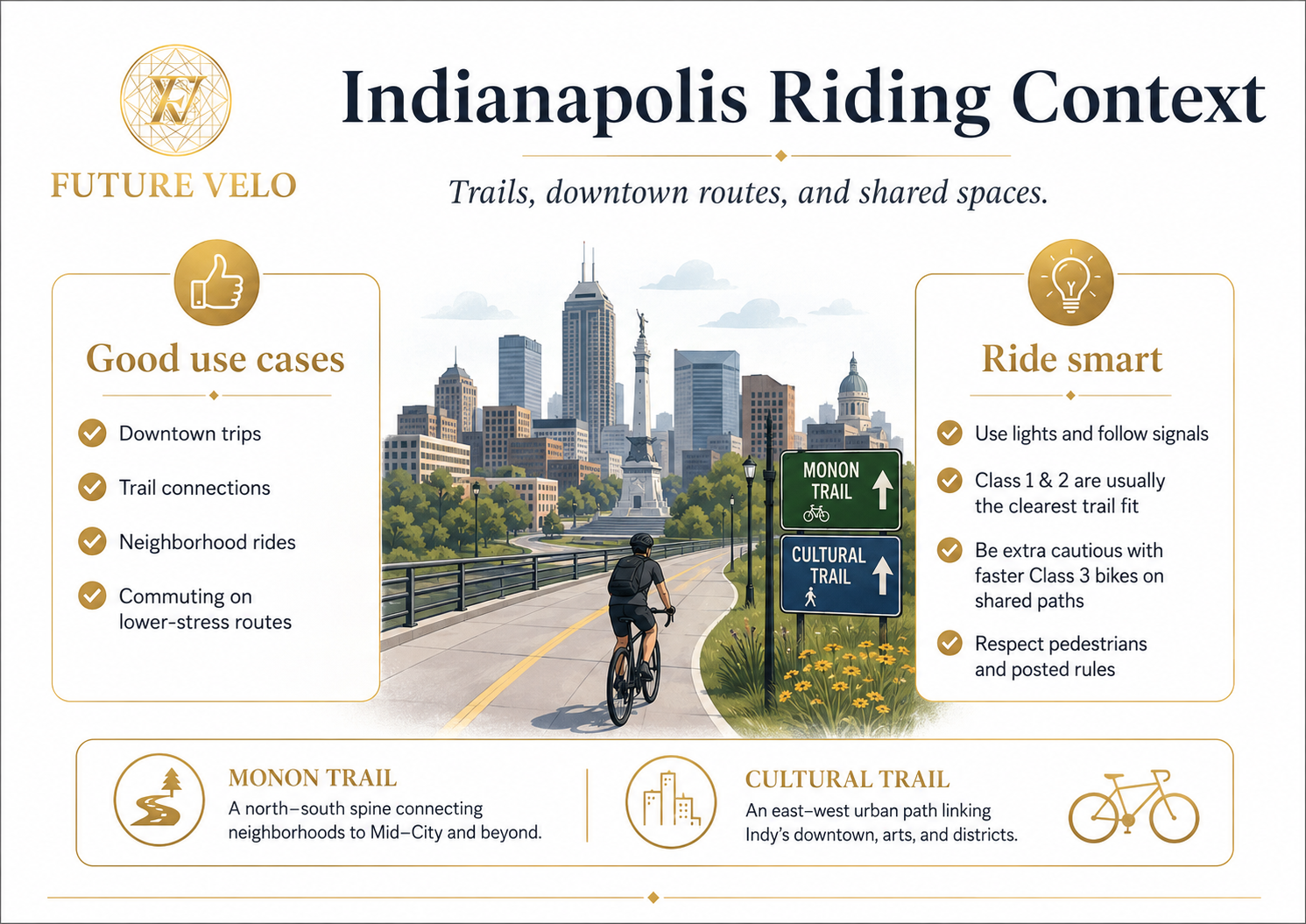
For Indianapolis riders, the practical takeaway is:
Class 1 and Class 2 are the clearest e-bike classes for trails.
Be careful with Class 3 e-bikes on trails and shared-use paths.
Use roads and bike lanes when a faster commuter e-bike is more appropriate.
Avoid e-motos, motorized scooters, dirt bikes, and unauthorized motorized vehicles on trails.
Ride slowly and respectfully around pedestrians.
Use lights, follow traffic signals, and choose lower-stress routes when possible.
What Parents Should Know Before Buying an E-Bike for a Teen
Parents should be especially careful when buying an e-bike or electric vehicle online.
A legal e-bike is not the same thing as an electric motorcycle. Some online products look like e-bikes but may be too powerful, too fast, or missing fully operable pedals. These vehicles may not be legal on trails, sidewalks, or bike paths.
Before buying for a teenager, parents should check:
Is it truly Class 1, Class 2, or Class 3?
Does it have pedals?
Is the motor 750 watts or less?
What is the top assisted speed?
Does it have a throttle?
Is it legal for the rider’s age?
Does the rider need a helmet?
Where will the rider actually use it?
Is it allowed on local trails?
Is it serviceable by a local shop?
For Class 3 e-bikes, Indiana does not allow riders under 15 to operate them, and anyone under 18 operating or riding as a passenger on a Class 3 e-bike must wear a properly fitted and fastened bicycle helmet.
How to Choose the Right E-Bike Class for Indiana Riding
Choosing the right e-bike class depends on where you ride.
Choose Class 1 if you want the simplest option for trails, greenways, fitness riding, and a traditional bicycle feel.
Choose Class 2 if you want throttle support for starts, short trips, errands, and casual transportation while staying within the 20 mph assisted speed limit.
Choose Class 3 if you want a faster commuter e-bike for roads, bike lanes, and longer rides where higher assisted speed makes sense.
A simple rule is:
Trails and greenways: Class 1 or Class 2 usually makes the most sense.
Roads and longer commuting: Class 3 may make sense.
Crowded pedestrian areas: slow down regardless of bike class.
Unclear rules: check signs, local ordinances, or city guidance before riding.
Final Thoughts
Indiana’s e-bike laws are not meant to make e-bike riding impossible. They are meant to separate legal e-bikes from faster motorized vehicles and create rules for where each type of vehicle belongs.
At Future Velo, we believe e-bikes are one of the best ways to make local transportation more practical, enjoyable, and accessible. They can help riders commute, run errands, explore trails, stay active, and replace short car trips when the route and conditions make sense. But as e-bikes become more popular, riders need to understand what they are riding, where they are allowed to ride, and how to share roads and trails responsibly.
For most riders, the key points are simple:
Indiana uses Class 1, Class 2, and Class 3 e-bike categories.
Class 1 and Class 2 are usually the easiest fit for trails and multipurpose paths.
Class 3 is faster and more restricted on paths.
Riders under 15 cannot operate Class 3 e-bikes.
Riders and passengers under 18 must wear helmets on Class 3 e-bikes.
Legal e-bikes generally do not require a driver’s license, registration, title, or auto insurance.
High-powered e-motos and electric dirt bikes are not the same as legal e-bikes.
Local rules in places like Carmel, Westfield, Fishers, Noblesville, and Indianapolis can affect where you can ride.
At Future Velo in Carmel, IN, our goal is to help riders choose e-bikes that are safe, practical, serviceable, and appropriate for the way they actually ride. Whether you are commuting through Indianapolis, riding the Monon in Carmel, exploring Hamilton County trails, or choosing an e-bike for everyday errands, understanding the law is part of riding responsibly.
The safest approach is to know your e-bike class, follow posted signs, keep speeds low on shared paths, yield to pedestrians, and choose a bike that matches the route you actually plan to ride.