

Mid-Drive vs Hub Motor E-Bikes: Which Is Better for Indiana Riders?
When shopping for an e-bike, many riders focus on battery size, speed, range, or price. Those details matter, but one of the most important parts of the bike is the motor system.
Most e-bikes use one of two main motor layouts: a mid-drive motor or a hub motor. Both can be good options, but they feel different, perform differently, and fit different types of riders.
For Indiana riders, the best choice depends on how you plan to ride. A casual neighborhood rider, commuter, cargo-bike parent, trail rider, or long-distance rider may not need the same motor system. The goal is not to say one motor is always better. The goal is to understand which motor makes the most sense for your route, comfort level, budget, and long-term service needs.
Quick Answer: What Is the Difference?
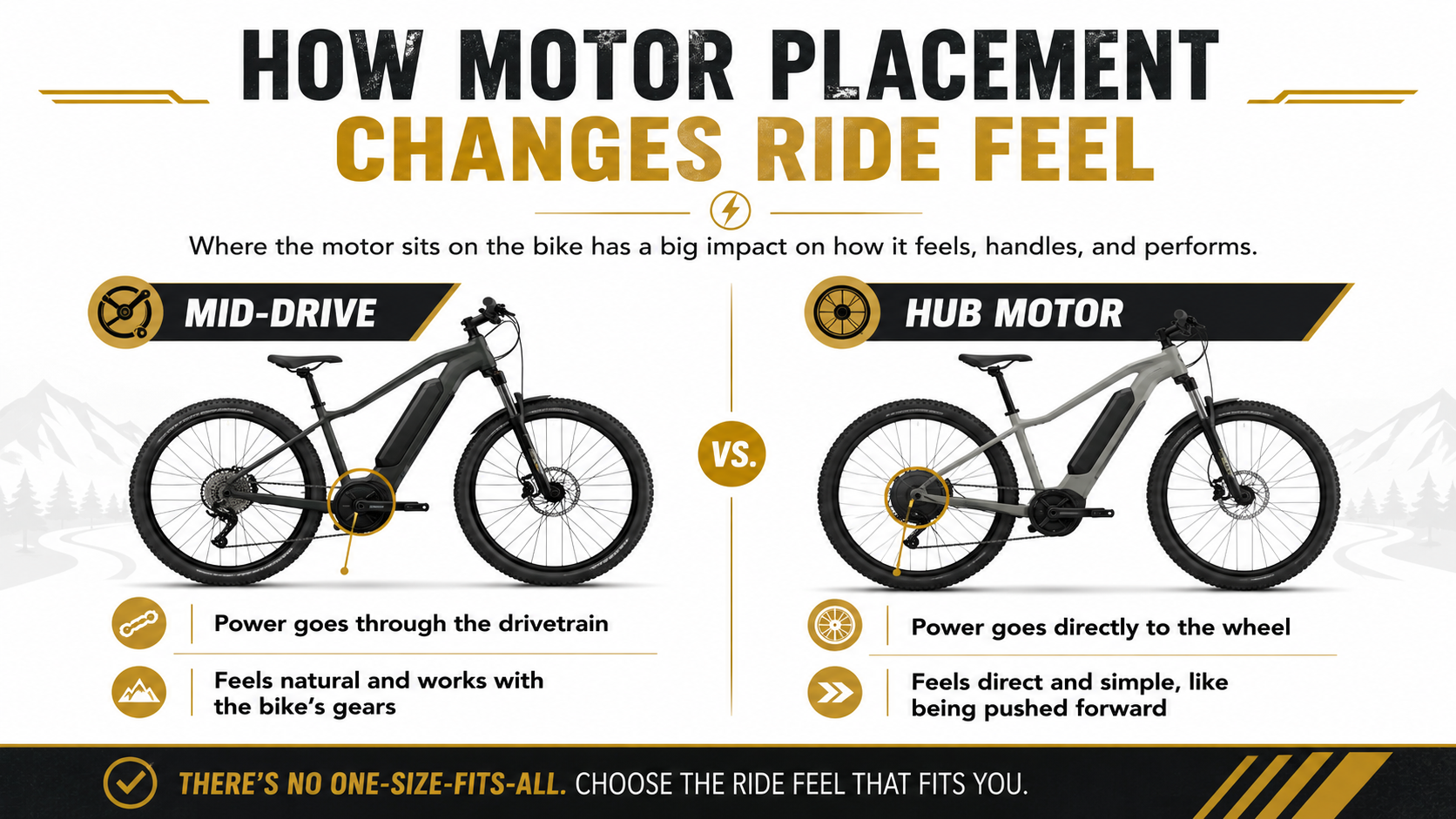
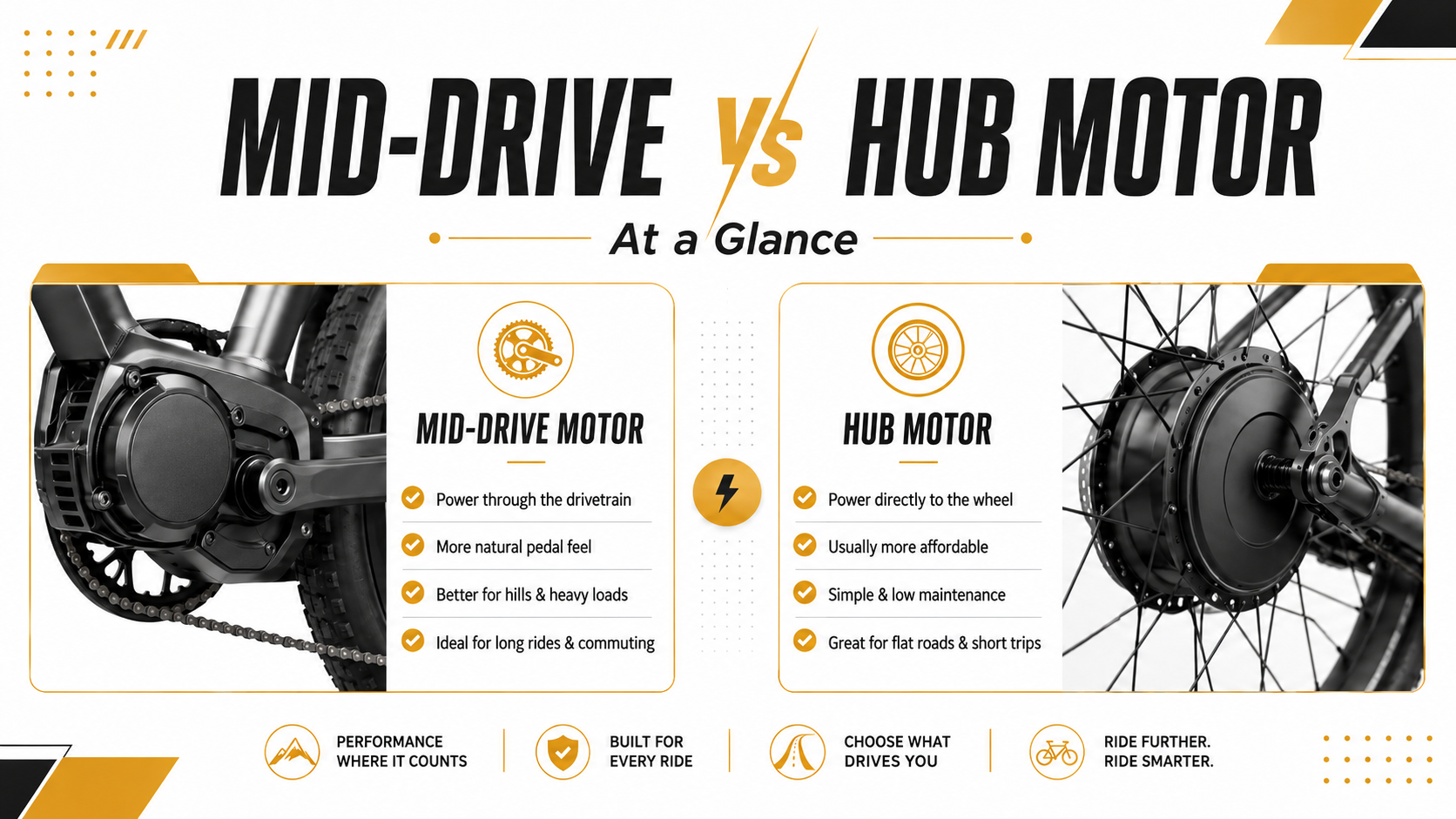
A mid-drive motor is located near the pedals, usually around the bottom bracket area of the bike. It sends power through the bike’s drivetrain, meaning the motor works with the chain, belt, gears, cassette, internal hub, or shifting system.
A hub motor is located inside one of the wheels, usually the rear wheel. Instead of sending power through the bike’s drivetrain, the motor turns the wheel directly.
In simple terms:
Mid-drive motors assist through the pedals and drivetrain.
Hub motors assist through the wheel.
Mid-drives usually feel more natural and efficient for hills, cargo, and varied riding.
Hub motors are often simpler, more affordable, and practical for casual riding or flatter routes.
The best choice depends on how and where you ride.
Why Motor Placement Matters
Motor placement affects how the bike feels.
On a traditional bicycle, the rider’s power goes through the pedals, chain, gears, and rear wheel. A mid-drive e-bike adds motor power into that same pedaling system. Because of this, the motor can take advantage of the bike’s gears. When the rider shifts properly, the motor can stay in a more efficient operating range.
A hub-drive e-bike works differently. The motor is in the wheel, so it does not use the bike’s gears in the same way. The motor turns the wheel directly. This can feel simple and powerful, especially on flat roads or short trips, but it may not feel as natural as a high-quality mid-drive system.
This is why two e-bikes with similar wattage can ride very differently. The motor’s location, torque output, controller tuning, sensors, drivetrain, bike weight, tire size, and frame geometry all affect the final ride.
What Is a Mid-Drive E-Bike?
A mid-drive e-bike places the motor near the center of the bike, close to the pedals. This location helps keep weight low and centered, which can improve balance and handling.
Mid-drive motors are common on premium commuter e-bikes, comfort e-bikes, cargo e-bikes, mountain e-bikes, and many Bosch, Shimano, Yamaha, Brose, and Specialized systems.
A mid-drive motor usually feels more like a natural extension of your pedaling. Instead of feeling like the bike is being pushed from the wheel, the motor responds to your pedal input. On many higher-quality systems, torque sensors measure how hard you are pedaling and adjust assistance accordingly.
That makes mid-drive motors especially strong for:
Riders who want a natural pedal-assist feel
Longer rides
Hills and bridges
Cargo bikes
Heavier riders or heavier loads
Commuting
Premium comfort e-bikes
Riders who care about balanced handling
Riders who want a refined, bicycle-like experience
Advantages of Mid-Drive Motors
1. More Natural Pedal Feel
Mid-drive motors often feel smoother because they assist through the same system the rider already uses: the pedals and drivetrain. When combined with torque sensing, the bike can respond more naturally to rider effort.
That means the bike may feel less like a scooter and more like a stronger version of a regular bicycle.
2. Better Use of Gears
Because a mid-drive motor works through the drivetrain, it can benefit from the bike’s gearing. When riding uphill, carrying cargo, or starting from a stop, the rider can shift into an easier gear. This helps both the rider and the motor work more efficiently.
This is one of the biggest reasons mid-drive e-bikes are often preferred for cargo bikes, hills, and longer rides.
3. Better Weight Balance
A mid-drive motor sits low and near the center of the bike. This can help the bike feel more balanced, especially compared with systems where extra weight is concentrated in the rear wheel.
For riders who care about handling, stability, and control, this can be a major advantage.
4. Stronger for Cargo and Frequent Riding
Cargo e-bikes, family e-bikes, and utility e-bikes often benefit from mid-drive systems because the motor can use the gears to move heavier loads more effectively.
For Indiana riders carrying groceries, work bags, child seats, or family cargo, this can make a meaningful difference.
5. Better for Premium Commuting
For regular commuting, a mid-drive motor can feel more refined and efficient. It is often paired with higher-quality components, hydraulic brakes, integrated lights, racks, fenders, and stronger dealer support.
This does not mean every commuter needs a mid-drive. But riders who use an e-bike frequently may appreciate the smoother ride and long-term support of a premium mid-drive system.
Disadvantages of Mid-Drive Motors
1. Higher Cost
Mid-drive e-bikes usually cost more. The motor system is more integrated, the frame design is more specialized, and the bike often uses higher-quality components.
For a rider who only wants occasional casual rides, the extra cost may not be necessary.
2. More Drivetrain Wear
Because the motor sends power through the chain, belt, cassette, derailleur, or internal hub, the drivetrain handles both human power and motor power.
This can increase wear, especially if the rider shifts poorly, rides in high-assist modes all the time, or carries heavy loads. A well-maintained mid-drive bike can last a long time, but it should be serviced properly.
3. More Complex Repairs
Mid-drive systems are often more proprietary. Diagnosis may require brand-specific tools, software, dealer support, or replacement parts.
A good mid-drive system from a strong brand can be very serviceable, but cheap or unsupported mid-drive systems can become difficult to repair.
4. Riders Need to Shift Correctly
A mid-drive motor rewards good shifting. If you always ride in the wrong gear, the motor may feel strained, the drivetrain may wear faster, and range may suffer.
For riders who do not want to think about shifting, an internally geared hub, automatic shifting system, Enviolo drivetrain, or a simpler hub-drive e-bike may be easier.
What Is a Hub Motor E-Bike?
A hub motor is built into the front or rear wheel. Most modern hub-drive e-bikes use rear hub motors because they provide better traction and more natural handling than many front hub setups.
Hub motors are common on value-focused e-bikes, throttle e-bikes, folding e-bikes, fat-tire e-bikes, casual commuter e-bikes, and many online e-bike brands.
A hub motor turns the wheel directly. This can make the bike feel simple, direct, and easy to understand. Many Class 2 throttle e-bikes use hub motors because the motor can power the wheel even when the rider is not pedaling.
Hub motors are especially strong for:
Casual riding
Flatter routes
Short errands
Budget-conscious buyers
Riders who want throttle support
Folding or compact e-bikes
Neighborhood riding
Simple commuting
Riders who want less drivetrain stress
Advantages of Hub Motors
1. Usually More Affordable
Hub motor e-bikes are often less expensive than mid-drive e-bikes. The motor system can be simpler to design and install, which helps keep the total bike cost lower.
For riders who want an e-bike for casual use, this can make hub-drive bikes a practical option.
2. Good for Flat and Moderate Terrain
Indiana is not mountainous, and many routes around suburbs, neighborhoods, city streets, and paved trails are relatively flat or moderate. For these conditions, a well-designed hub motor can work very well.
A hub motor can be a smart choice for riders who mostly ride local paths, errands, neighborhoods, or short commutes.
3. Throttle-Friendly
Many Class 2 e-bikes use hub motors because the motor can move the bike without pedal input, up to the legal assisted-speed limit.
This can help riders who want assistance starting from a stop, crossing intersections, or riding when they need a quick boost.
4. Less Wear on the Bicycle Drivetrain
Because the hub motor drives the wheel directly, it does not send motor power through the chain or belt in the same way a mid-drive does.
That means the drivetrain may experience less motor-related wear compared with a mid-drive system.
5. Simple Riding Experience
Many hub-drive e-bikes are easy to ride. The rider does not need to think as much about gear selection for the motor to work. For casual riders, that simplicity can be a benefit.
Disadvantages of Hub Motors
1. Less Natural Pedal Feel
Some hub motors can feel like they are pushing or pulling the bike rather than amplifying the rider’s pedaling. This is especially noticeable on cadence-sensor systems, where the motor turns on based on pedal movement rather than how hard the rider is pedaling.
Higher-quality hub systems can feel smooth, but the most natural pedal-assist systems are often mid-drive torque-sensing systems.
2. Less Efficient on Hills or Heavy Loads
Because a hub motor does not use the bike’s gears the same way a mid-drive does, it may work harder on hills, under heavy cargo, or during slow climbing.
For Indiana riders, this may not matter on short flat routes. But it can matter for cargo bikes, heavier riders, frequent commuting, bridges, steep driveways, or longer routes.
3. Wheel Weight and Handling
A hub motor adds weight to the wheel. On a rear hub motor, that means more weight at the back of the bike. On a front hub motor, it can affect steering feel.
This does not make hub motors bad, but it does change handling compared with a mid-drive system that keeps more weight centered.
4. Rear Flat Repairs Can Be Harder
If the motor is built into the rear wheel, fixing a rear flat can be more involved. The wheel is heavier and may have motor wiring that must be handled carefully.
This is one reason serviceability matters when choosing any e-bike.
5. Quality Varies Widely
Hub motors are used on both good e-bikes and very cheap e-bikes. The motor layout alone does not tell you whether the bike is reliable.
Battery quality, controller tuning, wiring, brakes, frame design, tire quality, and parts support all matter.
Mid-Drive vs Hub Motor: Which Is Better for Indiana?
For Indiana riders, the answer depends on the use case.
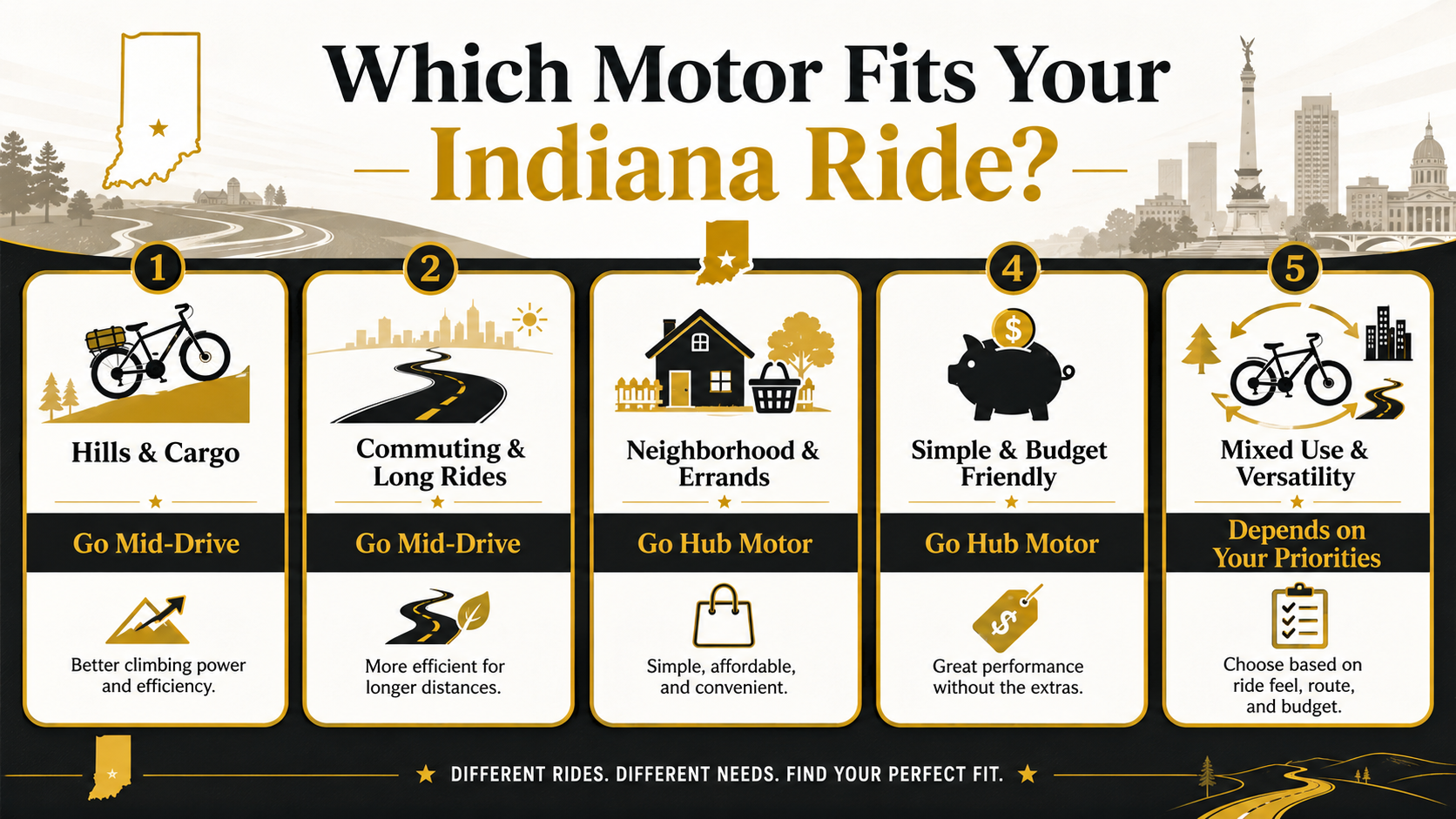
Choose a mid-drive motor if you want:
A more natural pedaling feel
Better climbing and cargo performance
Balanced handling
A premium commuter or comfort bike
Better performance with proper shifting
A bike for frequent use
A bike for longer rides
A cargo or family e-bike
A refined ride experience
Choose a hub motor if you want:
A more affordable e-bike
Simple casual riding
Throttle support
Short local trips
Neighborhood rides
Flatter routes
Compact or folding e-bike options
Less motor stress on the chain or drivetrain
A practical entry-level e-bike
Neither system is automatically better for everyone. A high-quality hub-drive e-bike can be better than a low-quality mid-drive e-bike. A premium mid-drive e-bike can be much better than a cheap hub-drive bike for frequent commuting or cargo use.
The whole bike matters.
How Indiana Terrain and Riding Conditions Affect the Choice
Indiana riders often deal with:
Paved trails
Neighborhood roads
City streets
Suburban routes
Stop-and-go riding
Hot summers
Cold winters
Wind
Rough pavement
Short errands
Longer regional rides
Trails such as the Monon and other greenways
For flat neighborhood rides or casual errands, a hub motor may be enough. For longer rides, stronger commuting, cargo, family use, or premium comfort, a mid-drive may be a better investment.
In places like Carmel, Westfield, Fishers, Noblesville, and Indianapolis, many riders use e-bikes for a mix of paths, roads, errands, and commuting. That mixed-use environment often rewards a bike that feels stable, has strong brakes, has good tires, and can be serviced locally.
Why Sensor Type Also Matters
Motor location is important, but sensor type also affects ride feel.
A cadence sensor detects that the pedals are moving. It may turn the motor on after the rider starts pedaling. This can feel simple, but sometimes less precise.
A torque sensor measures how hard the rider is pressing on the pedals. The harder the rider pedals, the more naturally the system can respond. This usually feels smoother and more bicycle-like.
Many premium mid-drive systems use torque sensing. Some hub-drive e-bikes also use torque sensors, and those can feel much better than basic cadence-sensor hub bikes.
A simple way to think about it:
Cadence sensor: “Are you pedaling?”
Torque sensor: “How hard are you pedaling?”
For riders who want a natural feel, torque sensing is often more important than wattage alone.
Why Wattage Does Not Tell the Whole Story
Many shoppers compare e-bikes by wattage, but wattage alone does not determine how good a bike feels.
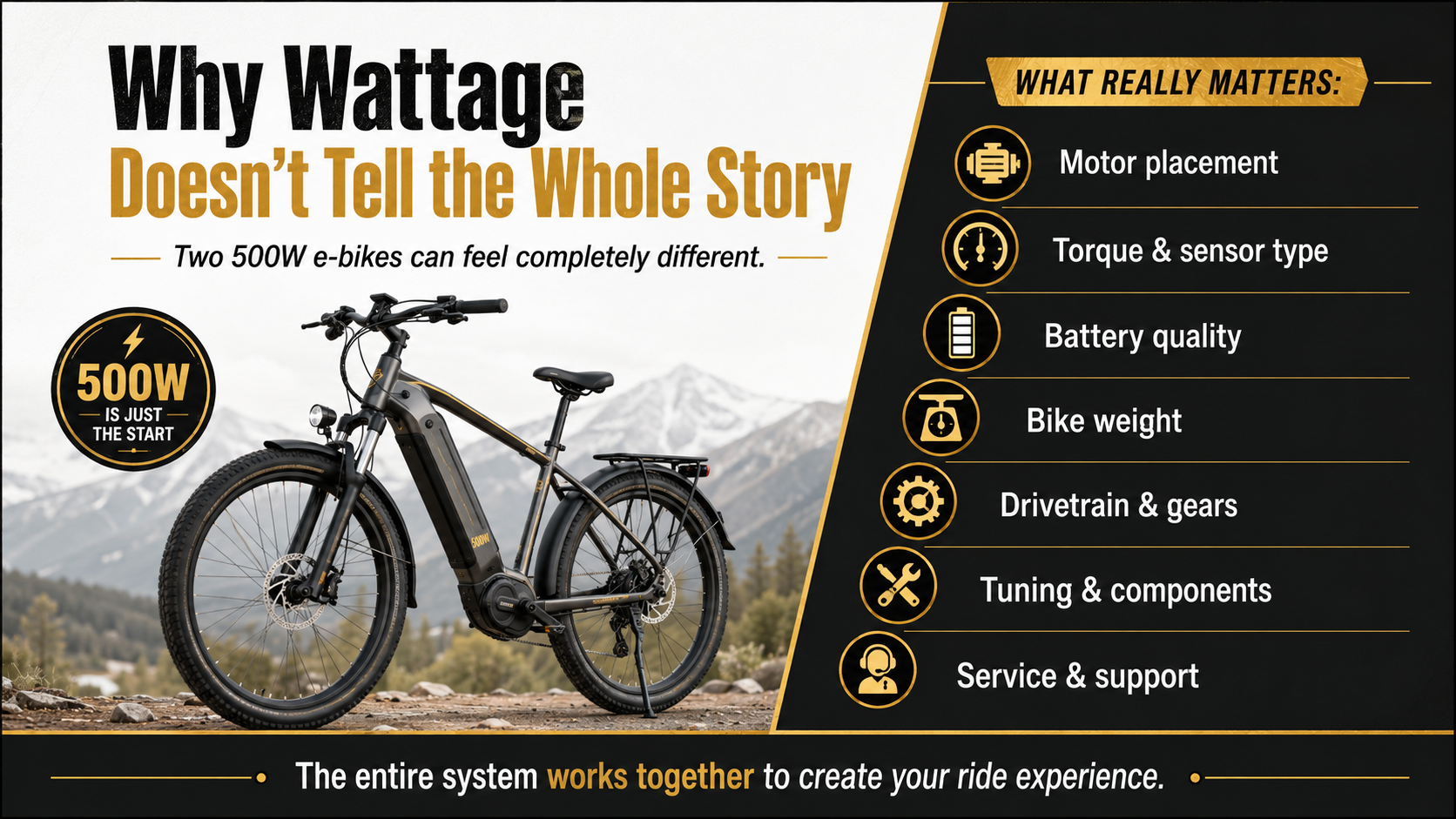
A 500W hub motor, a 500W mid-drive, and a 750W budget motor may all ride differently. What matters is the complete system:
Motor placement
Torque output
Sensor type
Controller tuning
Battery quality
Bike weight
Tire size
Gear range
Drivetrain type
Brake quality
Frame geometry
Service support
This is why test riding matters. Specs can tell part of the story, but the ride feel tells the rest.
How This Affects Price
Mid-drive e-bikes often cost more because the system is more integrated and usually paired with higher-end components. A premium mid-drive bike may include a refined motor system, torque sensing, better brakes, a higher-quality drivetrain, integrated lights, a better display, stronger frame design, and dealer support.
Hub-drive e-bikes often cost less because the motor system can be simpler and more economical. That can be good for casual riders, but buyers should still be careful. A low price may also mean lower-quality brakes, weaker parts support, a less refined battery system, or harder long-term repair.
The real question is not just “Which motor is cheaper?”
A better question is:
“How often will I ride, what will I carry, how far will I go, and how important is long-term service?”
Serviceability and Parts Support
Serviceability is a major part of choosing an e-bike motor system.
With mid-drive e-bikes, the motor and electronics may require brand-specific diagnostics or replacement parts. Strong brands with good dealer networks can make this manageable. Unsupported systems can be more difficult.
With hub-drive e-bikes, the motor itself may be simpler in concept, but the wiring, controller, display, throttle, and wheel assembly can still be brand-specific. Rear wheel service may also take longer because of motor wiring and wheel weight.
Before buying any e-bike, ask:
Can this motor system be diagnosed locally?
Are replacement parts available?
Is the battery replaceable?
Does the brand support dealers?
Are controllers, displays, sensors, and chargers available?
Can tires, tubes, brakes, and drivetrain parts be serviced easily?
Is the system safe and appropriate for Indiana e-bike rules?
A good e-bike is not just one that rides well on day one. It should also be supportable years later.
Final Recommendation
Choose a mid-drive e-bike if you want the most natural ride feel, better balance, stronger climbing and cargo performance, and a more refined commuter or comfort experience.
Choose a hub-drive e-bike if you want a simpler, more affordable, throttle-friendly option for flatter routes, casual rides, short trips, or entry-level e-bike ownership.
For many Indiana riders, the best choice depends less on the motor alone and more on the full bike: brakes, tires, battery, frame, drivetrain, service support, and how the bike feels during a test ride.
At Future Velo, we do not think every rider needs the same motor system. Mid-drive and hub-drive e-bikes both have a place.
For riders who want premium comfort, long-term commuting, cargo capacity, or a very natural pedal-assist feel, a mid-drive e-bike is often worth considering. For riders who want a more affordable, simple, throttle-friendly, or casual e-bike, a hub-drive system may be the better fit.
The most important thing is matching the bike to the rider.
A good e-bike should fit your body, route, comfort level, budget, maintenance expectations, and long-term service needs. Motor placement is only one part of that decision, but it is one of the most important parts to understand before buying.
If you are not sure which motor system fits your riding style, the best next step is to test ride both. A short test ride can often explain the difference better than any spec sheet.