

Can an E-Bike Replace a Car for Most Trips in Indiana?
For many Indiana riders, the question is not simply “Should I buy an e-bike?” It is “Could an e-bike realistically replace some of my car trips?”
The answer is often yes — especially for short local trips. An e-bike is not a complete replacement for a car in every situation, and it should not be treated as one. Cars are still better for long highway drives, severe weather, large cargo loads, and routes without safe bike access. However, research shows that e-bikes can reduce some motorized vehicle use, support physical activity, and make short-distance transportation more practical.
That matters because many daily trips are already short. According to U.S. Department of Energy transportation data, more than half of all daily trips in the United States in 2021 were less than three miles. That distance may feel too far to walk comfortably, but it is often very realistic on an e-bike.
For Indiana residents, this makes e-bikes especially useful for errands, commuting, local restaurants, parks, trails, campus transportation, neighborhood trips, and short rides between nearby destinations.
Why Short Trips Are the Best Place to Start
The strongest case for e-bikes is not that they replace every car trip. It is that they can replace some of the short trips where using a car is convenient but not always necessary.
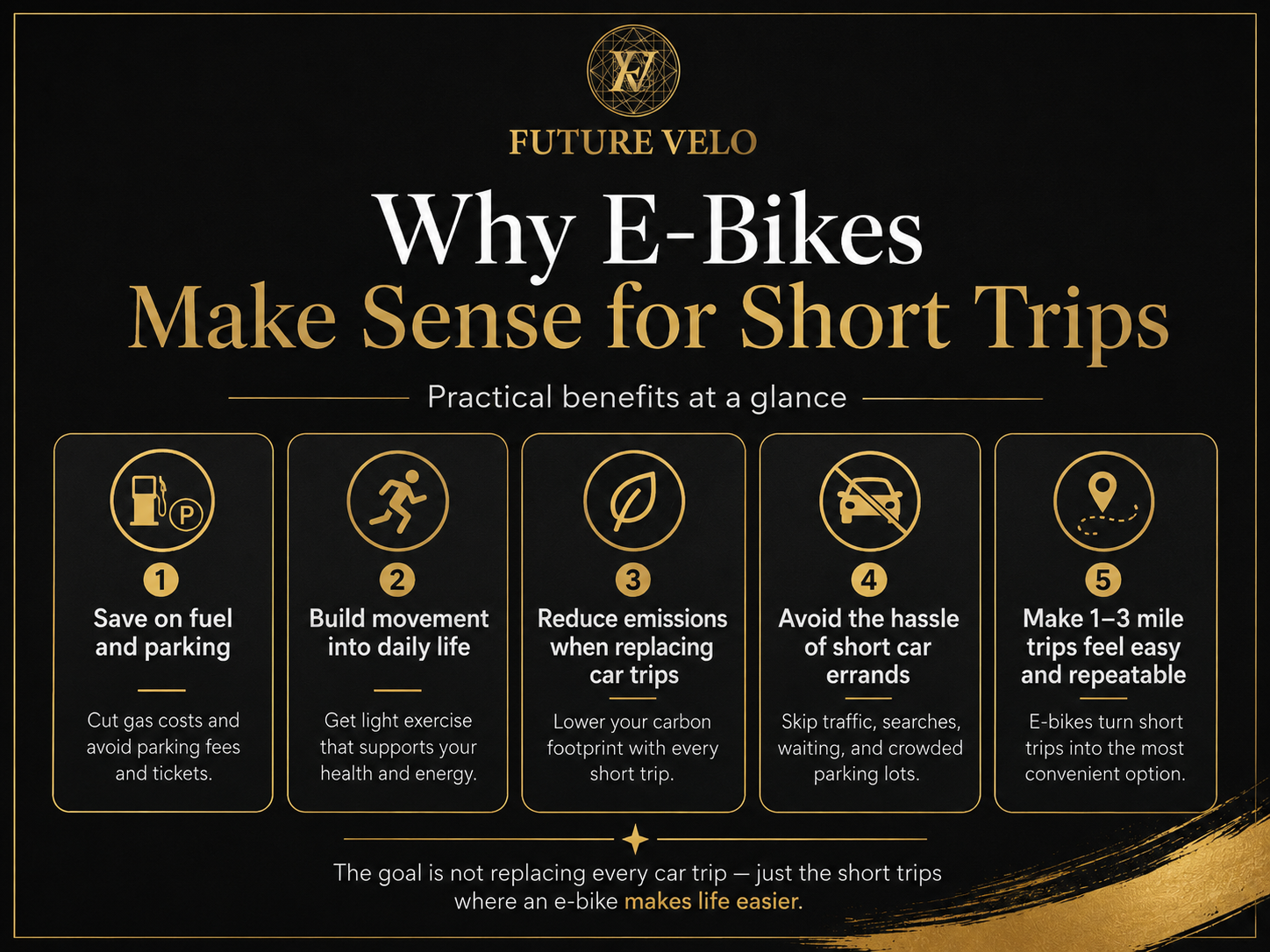
In Indiana, short trips can look different depending on where you live. In suburban communities, an e-bike may be useful for riding to a grocery store, restaurant, school, park, gym, or local trail. In city settings, an e-bike may help with commuting, parking, downtown travel, and connecting to public transit. In smaller towns, an e-bike may be useful for short rides to work, local shops, libraries, or community events.
Common short trips that may work well by e-bike include:
Riding to a nearby restaurant or coffee shop
Picking up a small grocery order
Going to a park or trail
Commuting a few miles to work
Traveling around a college campus
Riding to a library, gym, or community center
Visiting a friend nearby
Going to local events
Taking a child or cargo with a properly equipped cargo e-bike
These trips are where e-bikes are most realistic. They are faster than walking, less physically demanding than a traditional bike, easier to park than a car, and often more enjoyable for short-distance travel.
What Research Says About E-Bikes and Car Trip Replacement
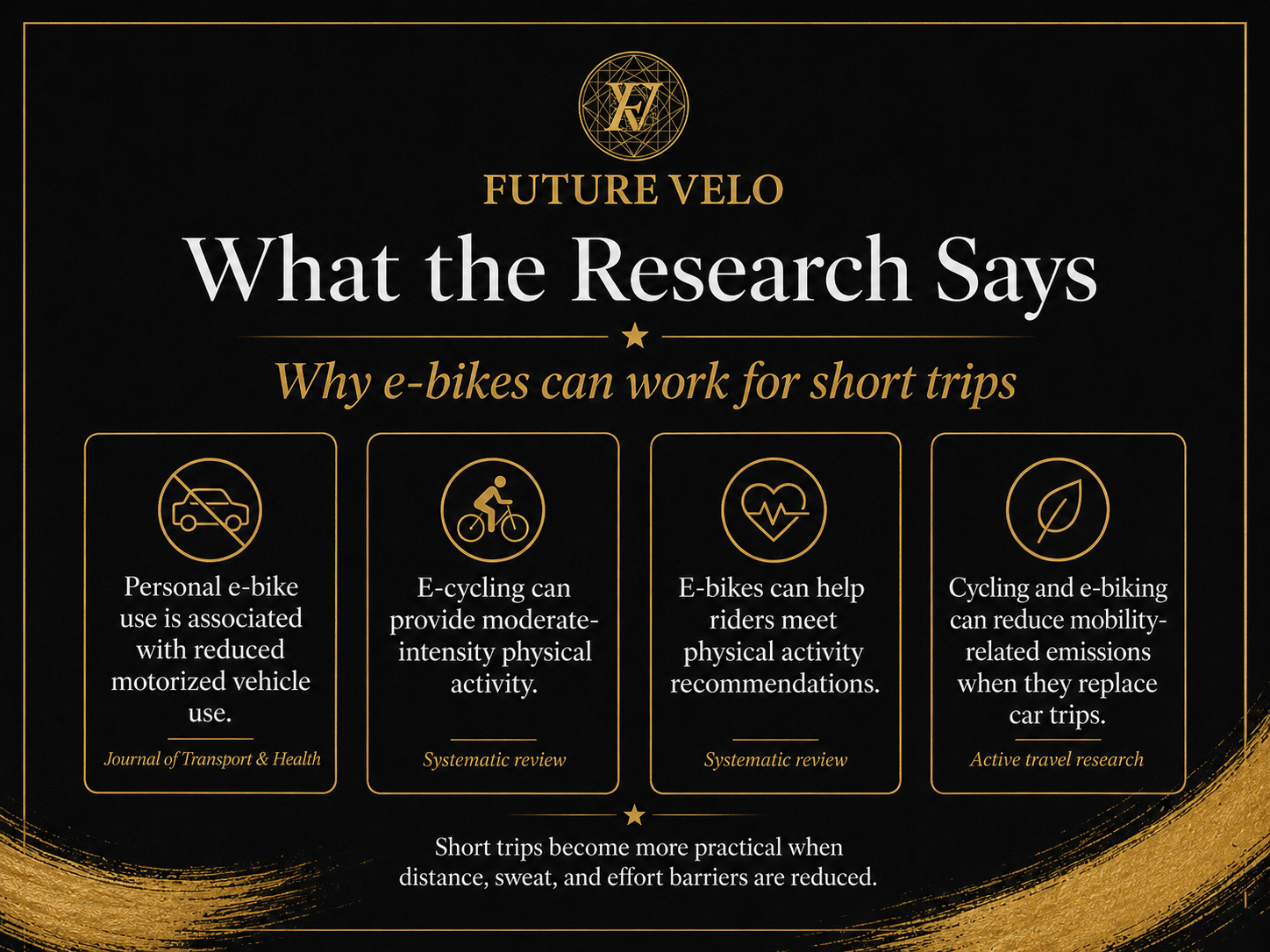
E-bikes are sometimes treated as recreational products, but research increasingly shows that they can function as real transportation.
A scoping review in the Journal of Transport & Health found that personal e-bike use is associated with reduced motorized vehicle use. That does not mean every e-bike owner stops driving. It means that when people have access to e-bikes, some trips that would have been made by car can shift to e-bike travel.
This is important for Indiana because many residents live in places where trips are short but still car-dependent. A traditional bike may feel unrealistic because of distance, hills, sweat, wind, or fitness concerns. An e-bike lowers those barriers. The motor assistance can make a three-mile errand, a five-mile commute, or a longer trail-connected ride feel more manageable.
A practical way to think about it is:
An e-bike does not need to replace your car. It only needs to replace the trips where a car is more than you actually need.
E-Bikes Still Provide Physical Activity
One common misconception is that e-bikes do all the work for the rider. Research does not support that simple view.
A systematic review on electrically assisted cycling found moderate evidence that e-cycling can provide moderate-intensity physical activity. The systematic review and meta-analysis found that e-cycling increases physiological activity compared with passive transportation, even though it is usually less intense than conventional cycling.
That is exactly why e-bikes are useful. They reduce the barrier to riding without removing movement entirely.
A short car trip provides almost no physical activity. A short e-bike trip still involves pedaling, balancing, steering, and spending time outdoors. For riders who want more movement in daily life without making every ride feel like a workout, e-bikes can be a practical middle ground.
This can be especially helpful for:
People returning to cycling after a long break
Older adults
Riders concerned about hills or distance
Commuters who do not want to arrive exhausted
People who want light-to-moderate activity built into daily life
Families looking for more outdoor transportation options
The best e-bike use is not about avoiding effort completely. It is about making riding realistic enough that people do it more often.
Environmental Benefits Depend on Replacing Car Trips
E-bikes are most environmentally useful when they replace car trips.
Research on active travel and climate impacts has found that cycling and e-biking can reduce mobility-related emissions, especially when they replace car travel. The biggest benefits come from avoided car trips, not simply adding extra recreational rides.
This is why short trips matter. A person does not need to replace every car trip to make a difference. Replacing a few short drives each week can reduce fuel use, local emissions, parking demand, and vehicle wear.
In Indiana, this may be most realistic for errands, neighborhood trips, trail access, short commutes, downtown travel, and campus transportation.
Why Indiana Is a Practical Place for E-Bike Use
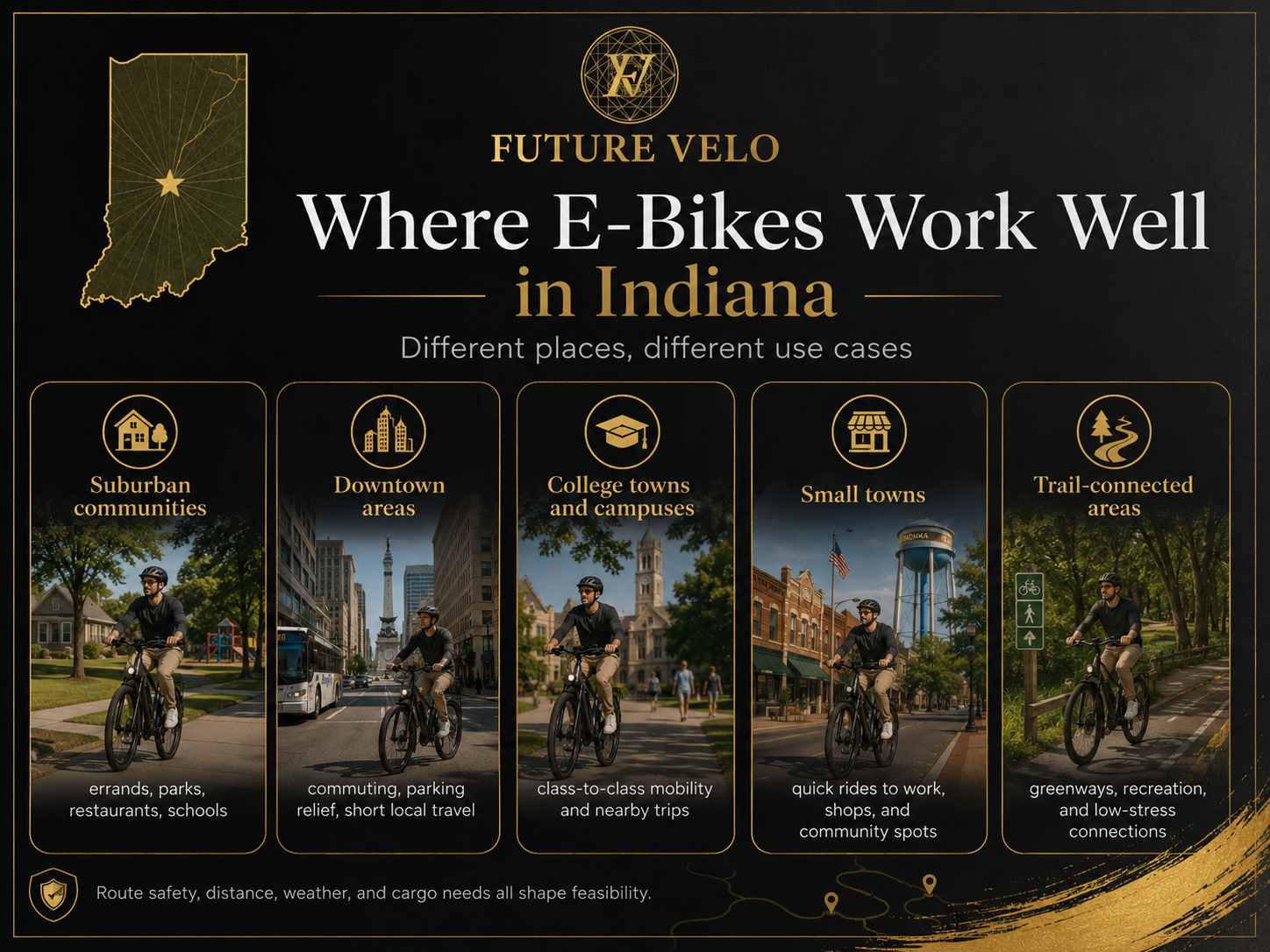
Indiana has a mix of suburban communities, small towns, college areas, downtown districts, rural roads, and connected trail systems. That variety means e-bikes will not work the same way everywhere, but they can still be useful in many parts of the state.
In suburban areas, e-bikes may work well for errands, parks, restaurants, and nearby schools. In denser city areas, they can help with parking, downtown mobility, and shorter commutes. In smaller towns, they may provide a simple way to travel between local destinations without starting a car. In college communities, they can be useful for campus transportation and nearby errands.
E-bike feasibility depends on:
Distance
Route safety
Weather
Traffic speed
Trail or bike-lane access
Cargo needs
Rider comfort
Battery range
Local rules
Serviceability
Indiana’s weather also matters. Cold winters, hot summers, wind, rain, and seasonal storms mean riders need to be realistic. An e-bike may be a great option on many days, but not during icy roads, severe thunderstorms, extreme heat, or unsafe riding conditions.
How This Can Work in Carmel
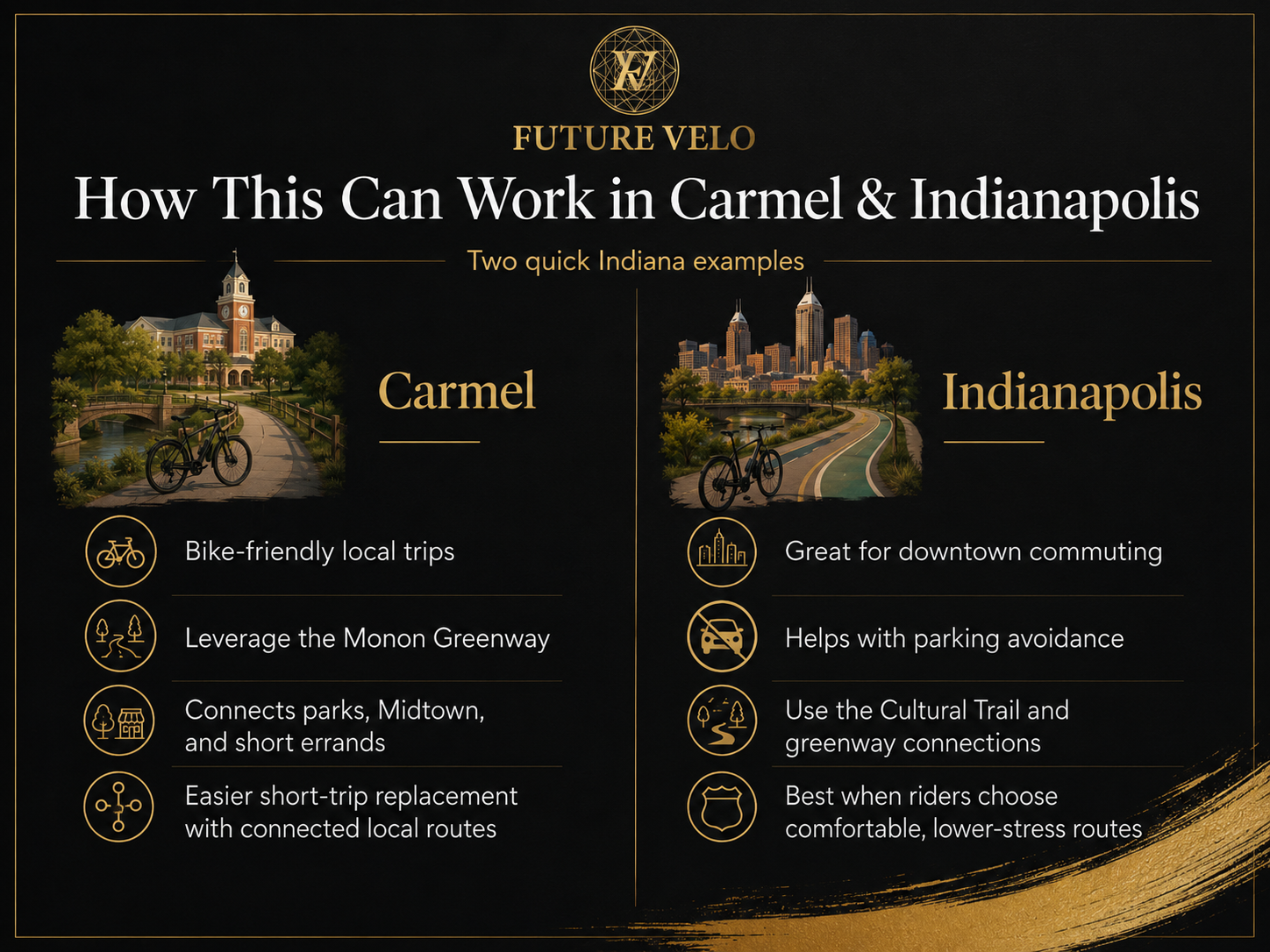
Carmel is one of the easier Indiana communities to imagine e-bike use because it has local destinations, trails, neighborhoods, and bike infrastructure.
The Carmel Access Bikeway includes cross-city routes and loops intended to connect riders to destinations throughout Carmel and nearby communities. The Monon Greenway also gives riders a major paved north-south route through the city.
For Carmel residents, e-bikes may be especially practical for:
Riding to Midtown
Going to City Center
Visiting the Arts & Design District
Riding to the Monon
Going to parks
Meeting friends nearby
Running small errands
Replacing short neighborhood drives
Carmel does not make every trip bike-friendly automatically, but it has enough local infrastructure that many short trips can be realistic with the right route planning.
How This Can Work in Indianapolis
Indianapolis has a different e-bike use case. Because it is larger and more urban, e-bikes may be especially useful for downtown travel, commuting, parking avoidance, and connecting neighborhoods.
The Indianapolis Cultural Trail connects downtown cultural districts and provides a major bike and pedestrian corridor. In areas where protected trails, lower-speed streets, greenways, or bike lanes are available, an e-bike can make short city trips more practical.
For Indianapolis riders, e-bikes may be useful for:
Downtown commuting
Riding between cultural districts
Avoiding parking challenges
Connecting to trails or greenways
Short neighborhood trips
Restaurant or event travel
Campus or hospital-area commuting
Combining biking with transit where practical
However, Indianapolis riders should be selective about routes. Some roads are much more comfortable than others, and traffic speed, lighting, lane design, and surface condition can make a major difference.
What Makes an E-Bike Practical for Replacing Short Trips?
The best e-bike for transportation is not always the fastest or most powerful one. It is the one that is easy enough to use regularly.
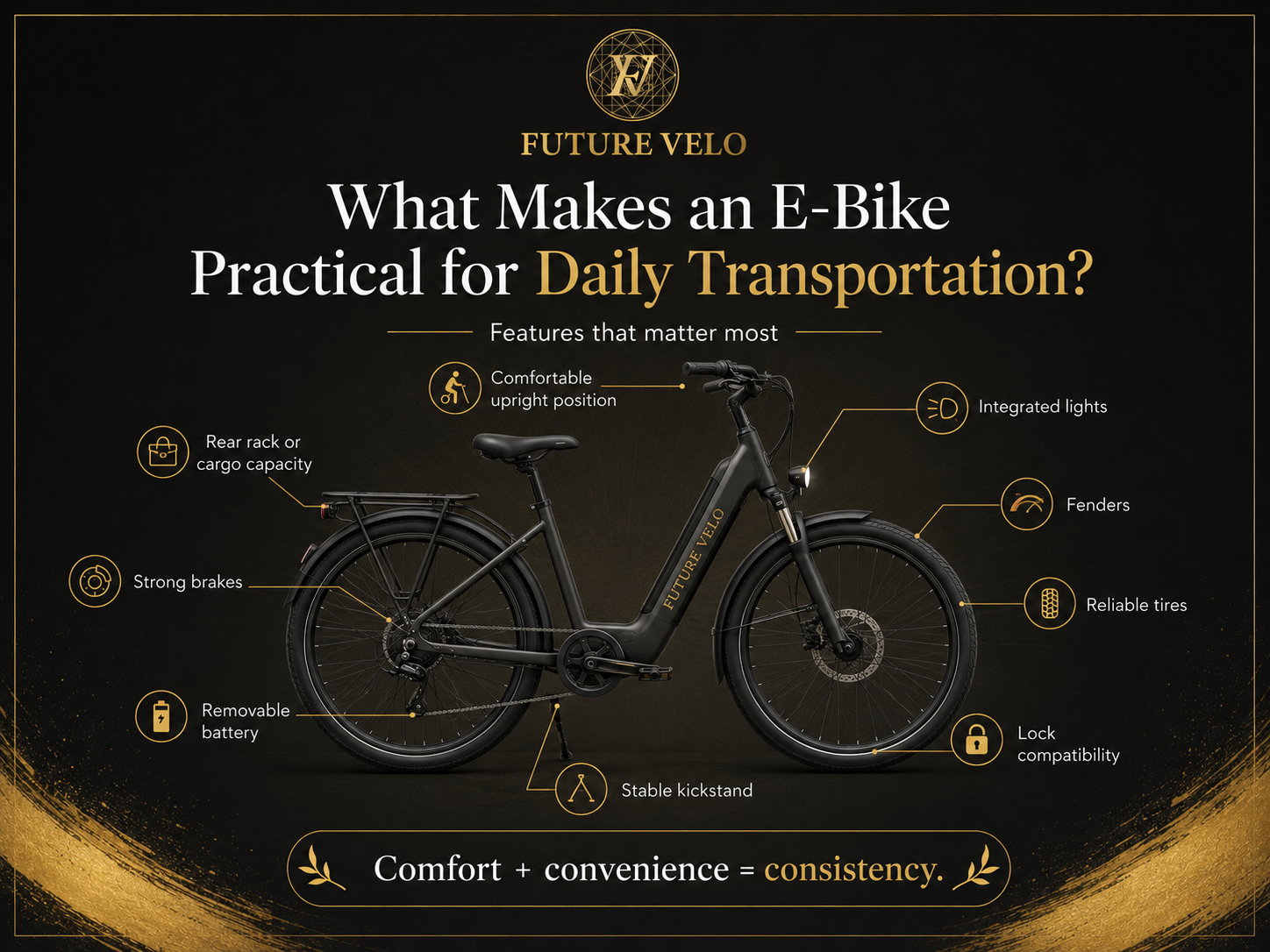
Important features include:
Comfortable upright riding position
Stable handling
Step-through or low-step frame
Integrated lights
Fenders
Rear rack or cargo compatibility
Strong brakes
Reliable tires
Good kickstand
Lock compatibility
Removable battery
Clear display
Local serviceability
Parts availability
These features matter because transportation is about consistency. A bike that feels uncomfortable, unstable, difficult to mount, hard to carry cargo on, or difficult to repair is less likely to replace car trips.
For most riders, comfort and convenience matter more than maximum speed.
Cargo Capacity Makes E-Bikes More Useful
One reason people drive short distances is not because the destination is far away. It is because they need to carry something.
That is why cargo capacity is important. A rear rack, basket, or pannier setup can make light errands much easier. A utility e-bike can carry larger loads. A cargo e-bike can make grocery runs, school trips, and family transportation more realistic.
Cargo capacity can determine whether an e-bike is just a fun ride or a true transportation tool.
For riders who want to replace more car trips, carrying ability matters as much as motor power.
When an E-Bike Should Not Replace a Car
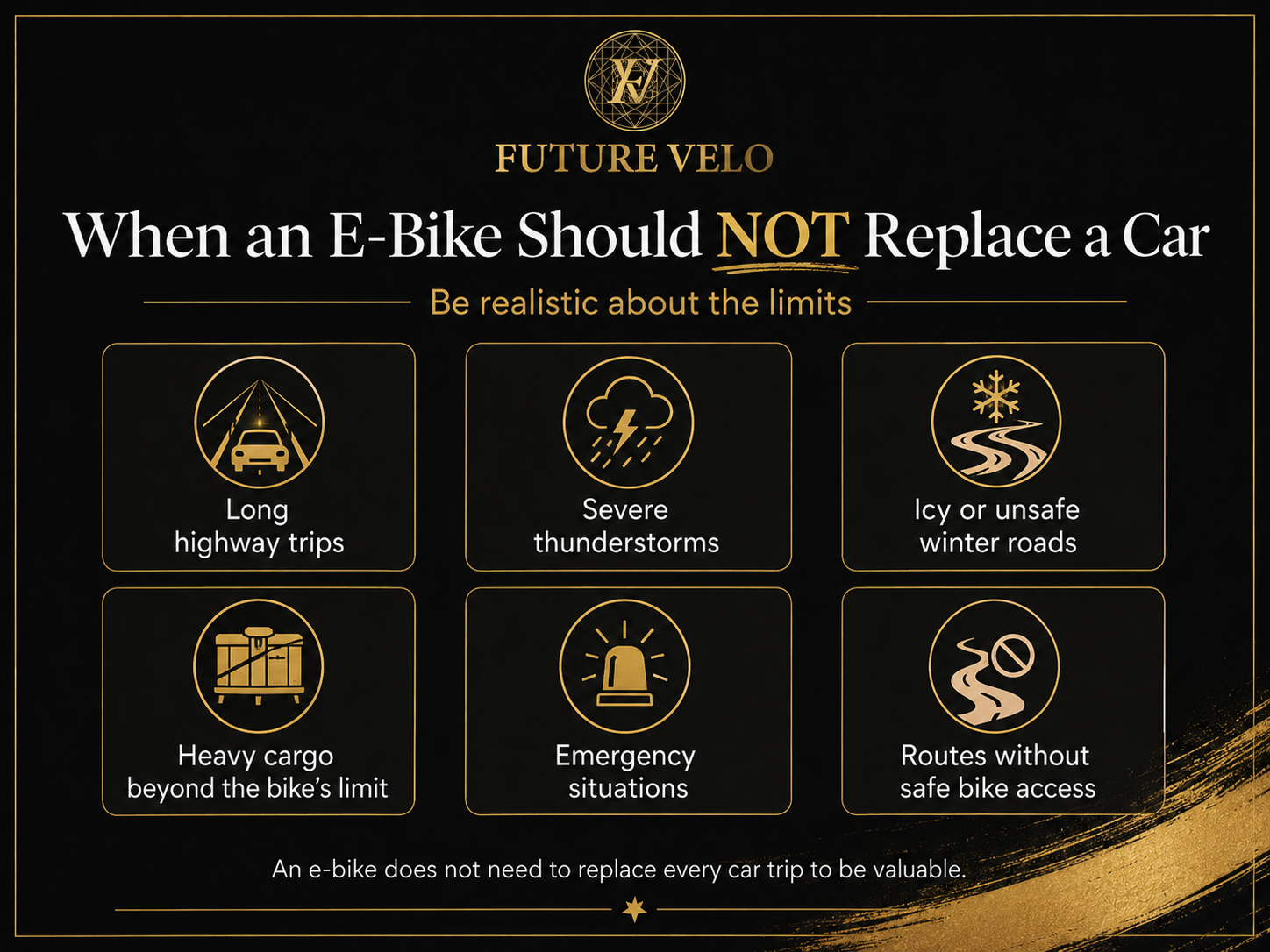
An e-bike is useful, but it is not always the right tool.
A car may still be better for:
Long highway trips
Severe thunderstorms
Icy roads
Heavy cargo beyond the bike’s rated capacity
Carrying multiple passengers without a cargo setup
Routes without safe bike access
Emergency situations
Trips that require highway speeds
Very cold or dangerous weather
This makes the argument more realistic. An e-bike does not need to replace every car trip to be valuable. It only needs to replace the trips where it makes sense.
A practical goal is:
Use the car when the car is necessary. Use the e-bike when the trip is short, safe, and practical.
Indiana E-Bike Rules Still Matter
Before using an e-bike for transportation, riders should understand Indiana’s e-bike class system.

Indiana recognizes Class 1, Class 2, and Class 3 e-bikes. These classes are based on motor wattage, throttle use, pedal assist, and maximum assisted speed. This matters because not every electric two-wheel vehicle is legally treated the same way, and not every e-bike class is appropriate for every route or trail.
Riders should check local rules, trail rules, and state guidance before assuming a specific e-bike is allowed everywhere a regular bicycle is allowed.
How to Make E-Bike Transportation Easier
A few setup choices can make e-bike transportation much more realistic.
Helpful additions include:
Panniers or baskets
A strong lock
Integrated or rechargeable lights
Fenders
A mirror
Comfortable saddle
Rear rack
Phone mount
Weather-appropriate clothing
Helmet
Battery charging routine
Battery care also matters in Indiana. Cold winters and hot summers can affect battery performance and storage. If the bike has a removable battery, indoor storage and charging can make daily use more reliable, especially during winter and summer temperature extremes.
Serviceability Matters More When the Bike Becomes Transportation
If an e-bike becomes part of daily transportation, reliability matters more.
A recreational bike can be out of service for a while without disrupting life too much. But if an e-bike is used for commuting, errands, or family trips, the rider needs dependable support.
Before choosing an e-bike for transportation, riders should ask:
Can the bike be serviced locally?
Are replacement parts available?
Can the battery and charger be replaced if needed?
Can the electrical system be diagnosed?
Are brakes, tires, and drivetrain parts accessible?
Does the brand provide warranty support?
Is the bike appropriate for Indiana e-bike rules?
A practical transportation e-bike should not only ride well on day one. It should also be supportable several years later.
Final Thoughts
An e-bike will not replace every car trip. But for many riders across Indiana, it can replace some of the most common short trips.
The strongest case for e-bikes is not that they eliminate cars completely. It is that they make local transportation more flexible. They can turn a short drive into an active outdoor trip, reduce the need for parking, support moderate physical activity, and lower emissions when they replace car travel.
This can work in many parts of Indiana, from suburban communities like Carmel to denser urban areas like Indianapolis, as long as riders choose safe routes, understand local rules, and use an e-bike that fits their real transportation needs.
The best way to think about an e-bike is simple:
Use it for the trips where it makes life easier.
For some riders, that may mean one or two errands a week. For others, it may mean commuting, grocery runs, school trips, downtown travel, or regular trail access. The more comfortable, practical, and serviceable the e-bike is, the more likely it is to become part of everyday life.
At Future Velo in Carmel, Indiana, we help riders test ride and compare e-bikes for real daily use. If you are wondering whether an e-bike can replace some of your short car trips, visit Future Velo and we can help you find the right comfort, commuter, cargo, or utility e-bike for your lifestyle.